Königssee, Germany
We came to Königssee knowing about the boat ride, St. Bartholomä and the wooden boathouse at Obersee. After spending two full days and our arrival evening here, though, some of the things I remember most happened away from those familiar views.
We stayed in Schönau am Königssee and travelled entirely without a car. Over the three days, we took the boat to Salet, walked past Obersee and Fischunkelalm towards Röthbachfall, stopped at St. Bartholomä, and spent our second day walking from Ramsau through Zauberwald to Hintersee. We also kept coming back to Königssee itself, sometimes early when it was busy and once in the evening after the boats had stopped.
If you enjoy hiking and don't want your visit to Königssee to begin and end with the boat ride, this is how our three days looked.
Our trip at a glance
- When: August 2026
- Time: Arrival evening plus 2 full days
- Base: Schönau am Königssee
- Transport: Public transport, boats and walking
- Stayed at: Explorer Hotel Berchtesgaden
- Best for: Hiking, lakes and a slower visit beyond the main boat stops
Our three days
- Day 1 — Arrival evening: Unterschönau → SalzAlpenSteig → Königssee Seelände.
- Day 2 — Königssee and Obersee: Boat to Salet → Obersee → Fischunkelalm → Röthbachfall → St. Bartholomä.
- Day 3 — Ramsau and Hintersee: Ramsau Kirche → Ramsauer Ache → Zauberwald → Hintersee → Malerwinkel.
Königssee after the boats had stopped
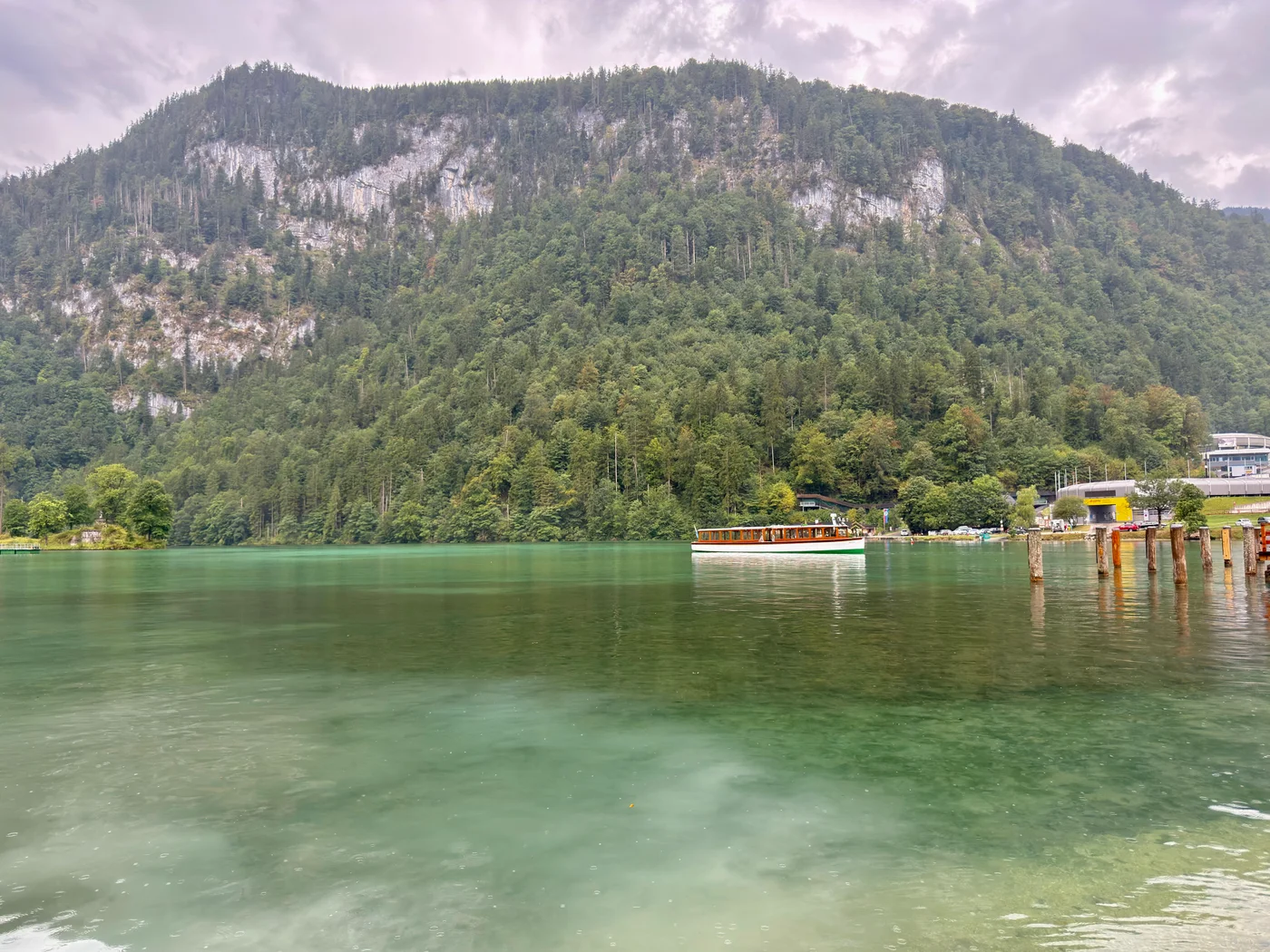
After travelling from Berlin, we checked into Explorer Hotel Berchtesgaden. Our base was in the quieter, more rural surroundings of Schönau am Königssee, roughly a 25-minute walk from the lake.
Later in the evening, we headed towards Königssee on foot. The walk took us past meadows, scattered houses and small stretches of countryside, where we came across sheep and alpacas along the way. We also passed a section of the SalzAlpenSteig before continuing towards Seelände.
By the time we reached Königssee at around 7 pm, the daytime activity had almost disappeared. The boats had stopped moving across the lake, most shops and restaurants were closed, and only a few families were still around the waterfront. It was an unusual first impression of a place we would see much busier the following morning.
We sat beside the lake and put our feet into the water. It was cold, but what struck me more was how clean it looked. Close to shore, I could see easily through the water, and with no boats passing, the surface had settled enough to reflect parts of the surrounding mountains.
Across Königssee to Salet
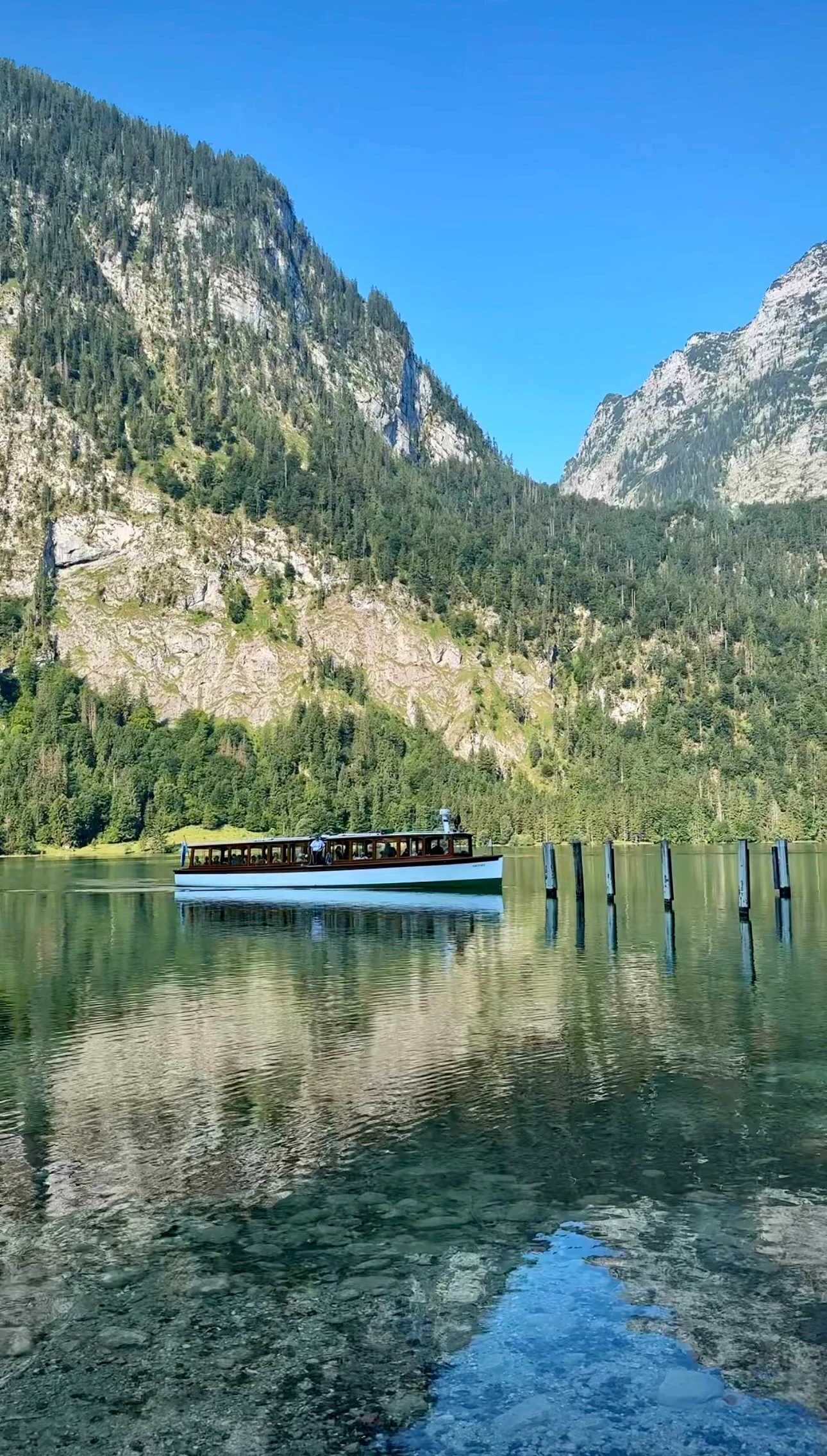
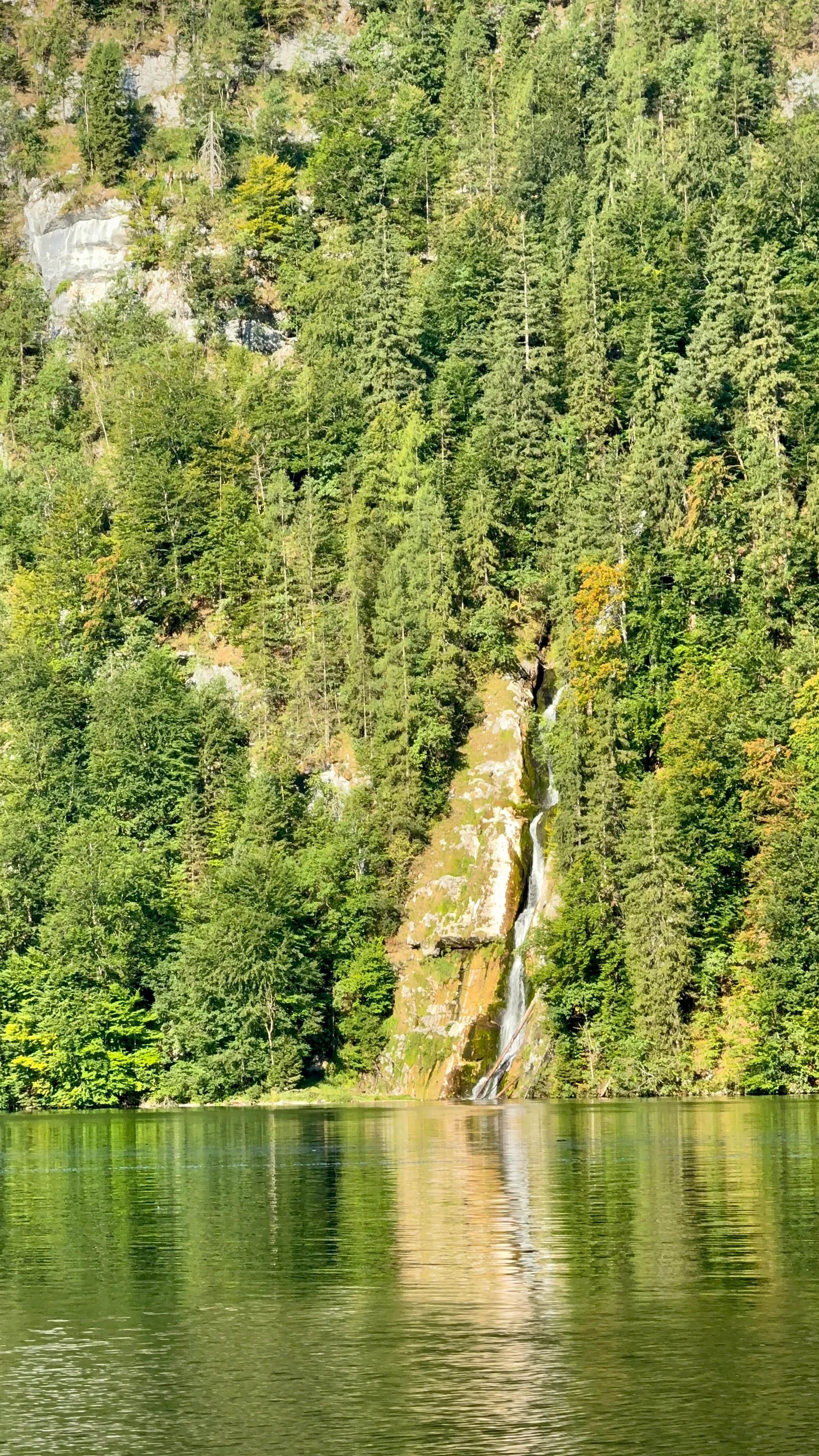
The next morning, Seelände was busy again. We had booked return tickets to Salet online for €29.80 per person and left at around 8 am. The ticket allowed us to interrupt the journey at St. Bartholomä, so we planned to travel all the way to Salet first and visit the church on the return. Booking online did not reserve seats on a particular departure, and boarding was effectively first come, first served. Although we could have taken the first boat available to us, we would have been among the last passengers getting on. Instead, we waited for the next boat, which was already at the pier, and had a much better choice of seats. The right-hand side in the direction of travel worked particularly well for us.
Königssee has a long tradition of electric passenger boats, and the relative quiet on the water suits the setting. The lake is closely enclosed by forest and rock, and from water level the mountains often seem to rise directly from the shore. The boat commentary was in German, which meant we understood only parts of it, but one tradition needed no translation. Near the Echowand, the boat stopped and the boatman played a short melody on a trumpet towards the mountain wall. A moment later, the notes returned across the water.
I had read about the echo before the trip and expected it to be the part of the crossing I remembered most, but what stayed with me happened later as the boat turned towards St. Bartholomä. At first, the church remained hidden. I knew we were approaching the stop, but ahead of us there was still only water and the mountains closing around it. I kept watching the shoreline, waiting for the familiar image to appear.
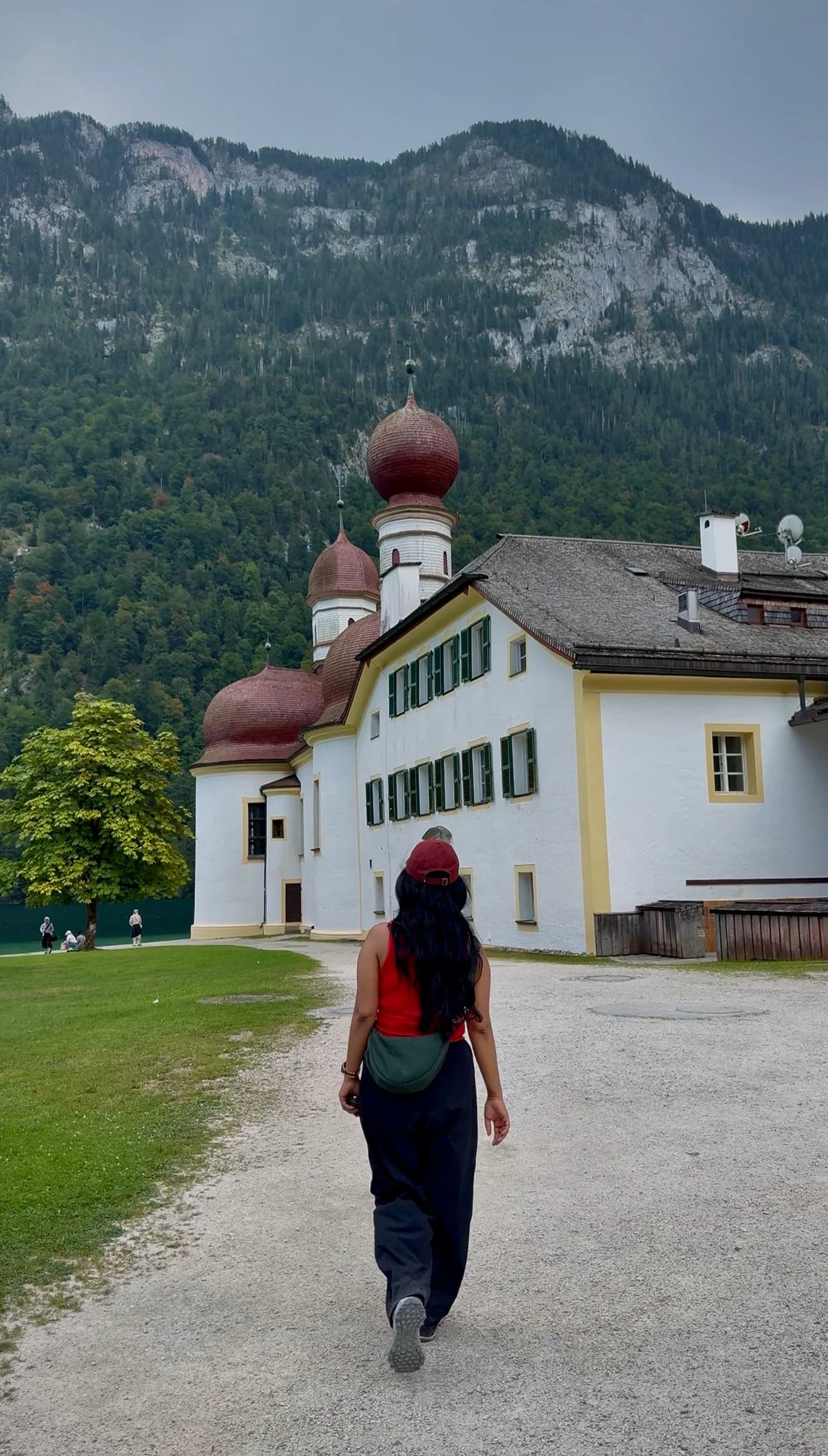
Eventually, the boat moved far enough around the bend and the small white church with its red onion domes came into view beneath the mountains. St. Bartholomä appears in so many photographs of Königssee that I thought seeing it for the first time might feel strangely familiar. Instead, it was the slow reveal from the boat that made the strongest impression.
When we reached the landing, we stayed on board. We wanted to use the cooler part of the morning for the longer walk beyond Obersee, so we left St. Bartholomä for the return journey.
From Salet to Obersee and Fischunkelalm
We reached Salet at around 9 am. From the landing, the first walk towards Obersee is straightforward, and after only about twenty minutes the wooden boathouse appeared beside the water: a timber hut at the edge of the narrow lake, with mountains rising at the far end.
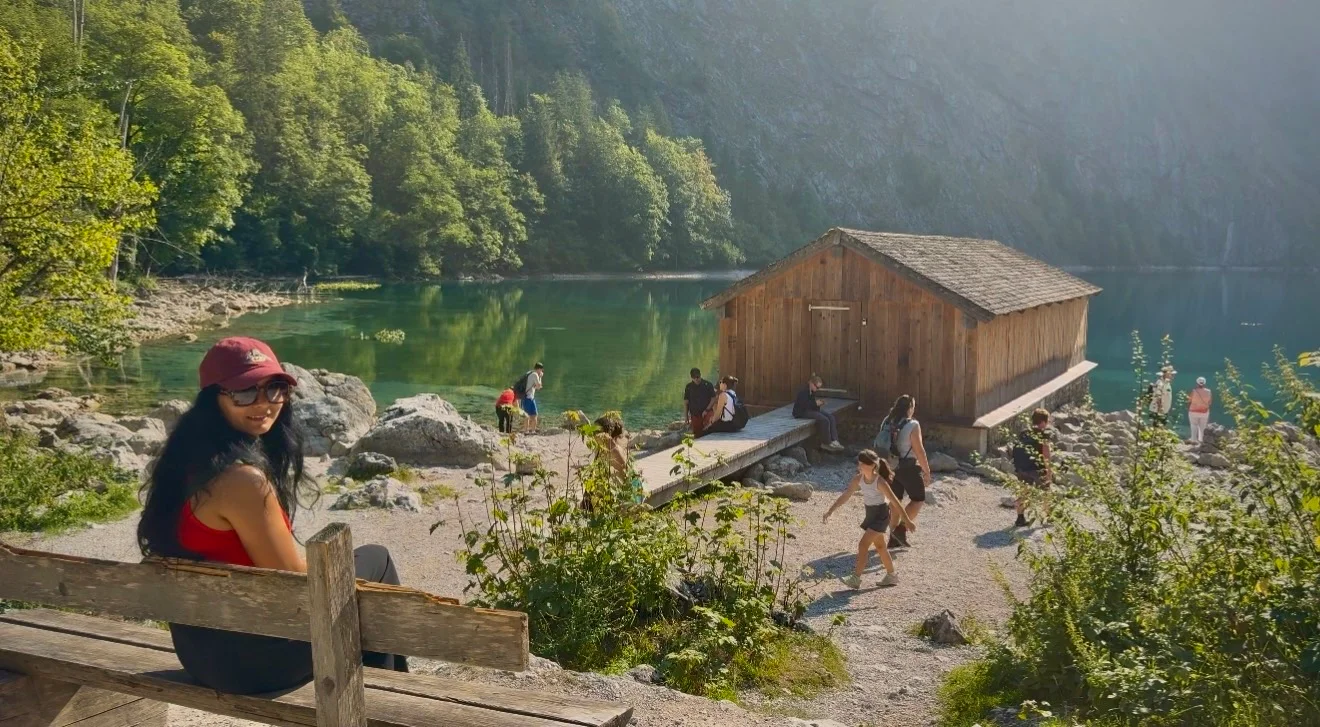
What I noticed was how simple the setting actually is. There is no large viewing area around the boathouse. The path reaches the shore, passes it, and continues. At around 9:20 am there were still relatively few people around, while on our return later in the afternoon the same spot was noticeably busier.
Beyond the boathouse, the nature of the walk changes. The easy approach becomes a narrower trail running along the side of Obersee, with sections climbing above the water. We crossed uneven stone and wooden steps, rockier ground, and places where steel cables or railings provided support. I would not call the normal route difficult, but I would also not describe the entire walk to Fischunkelalm as an easy lakeside stroll. The first fifteen or twenty minutes from Salet can give you the wrong impression.
One thing I liked about this part of the walk was that Obersee never disappeared for very long. Every time the trail climbed, we seemed to get another view of the lake from a slightly different height.
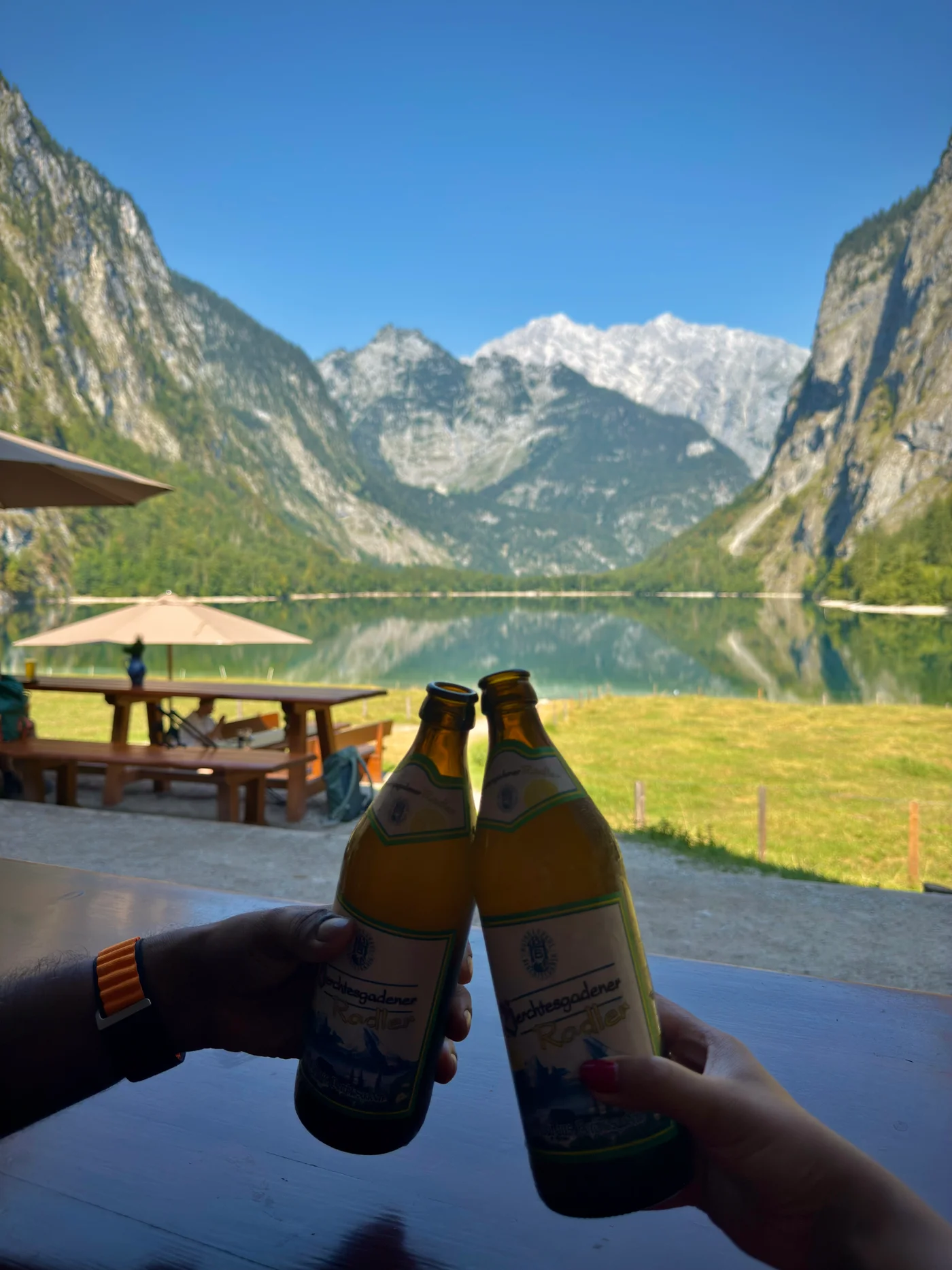
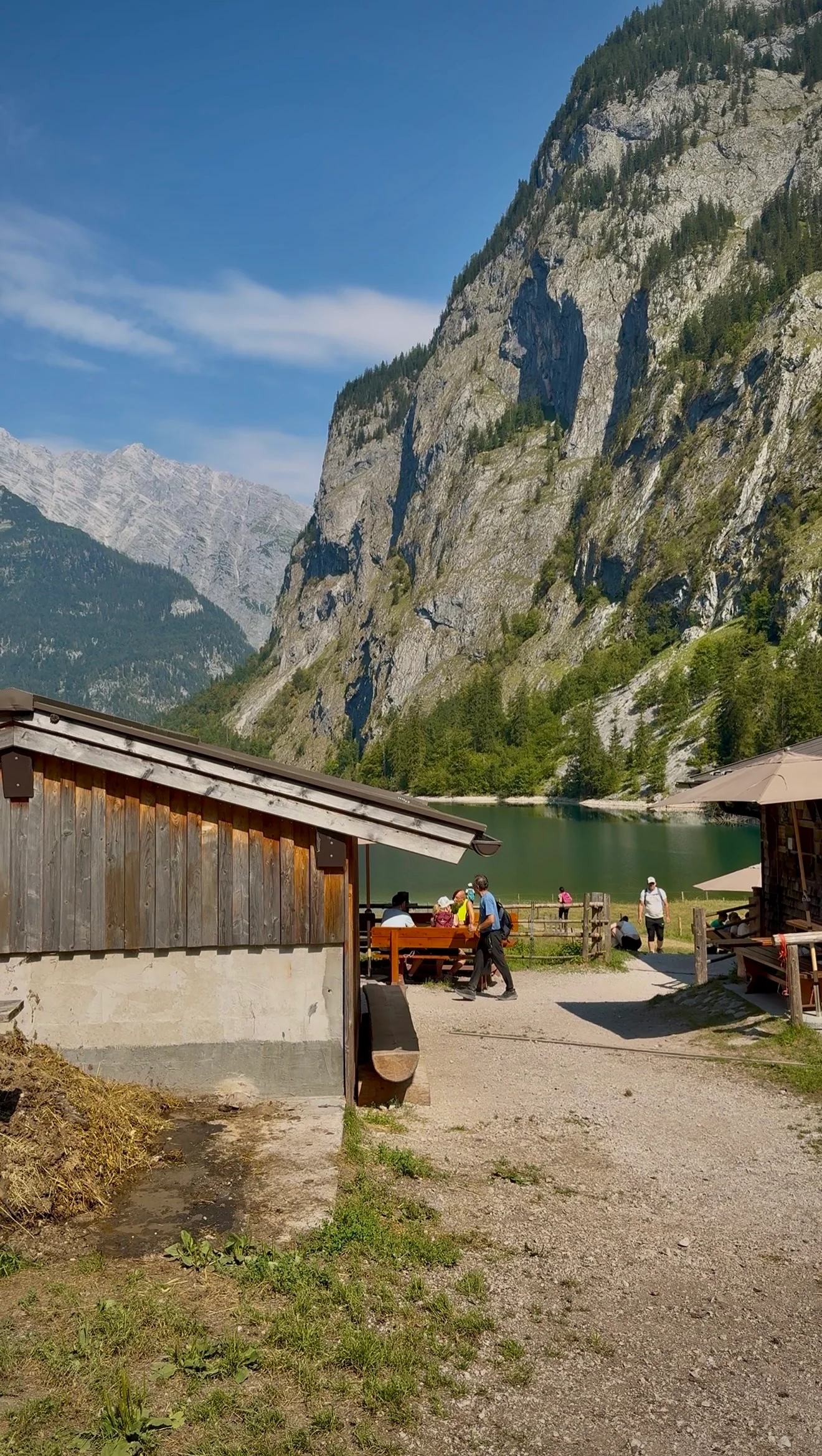
We ordered two Berchtesgadener Radlers and found a place in the shade facing back towards Obersee. After the rockier section of the walk, sitting there for twenty minutes was exactly the right decision. They were also serving fresh buttermilk, which we considered ordering before deciding to leave it for the return. At that point, we had no idea how much we would want it later.
Towards Röthbachfall
Maintained route at a glance: The return walk from Salet to the usual Röthbachfall area is approximately 8 km, with around 270 metres of ascent and roughly two and a half hours of walking time before stops. These published figures do not include the unmaintained climb we followed later.
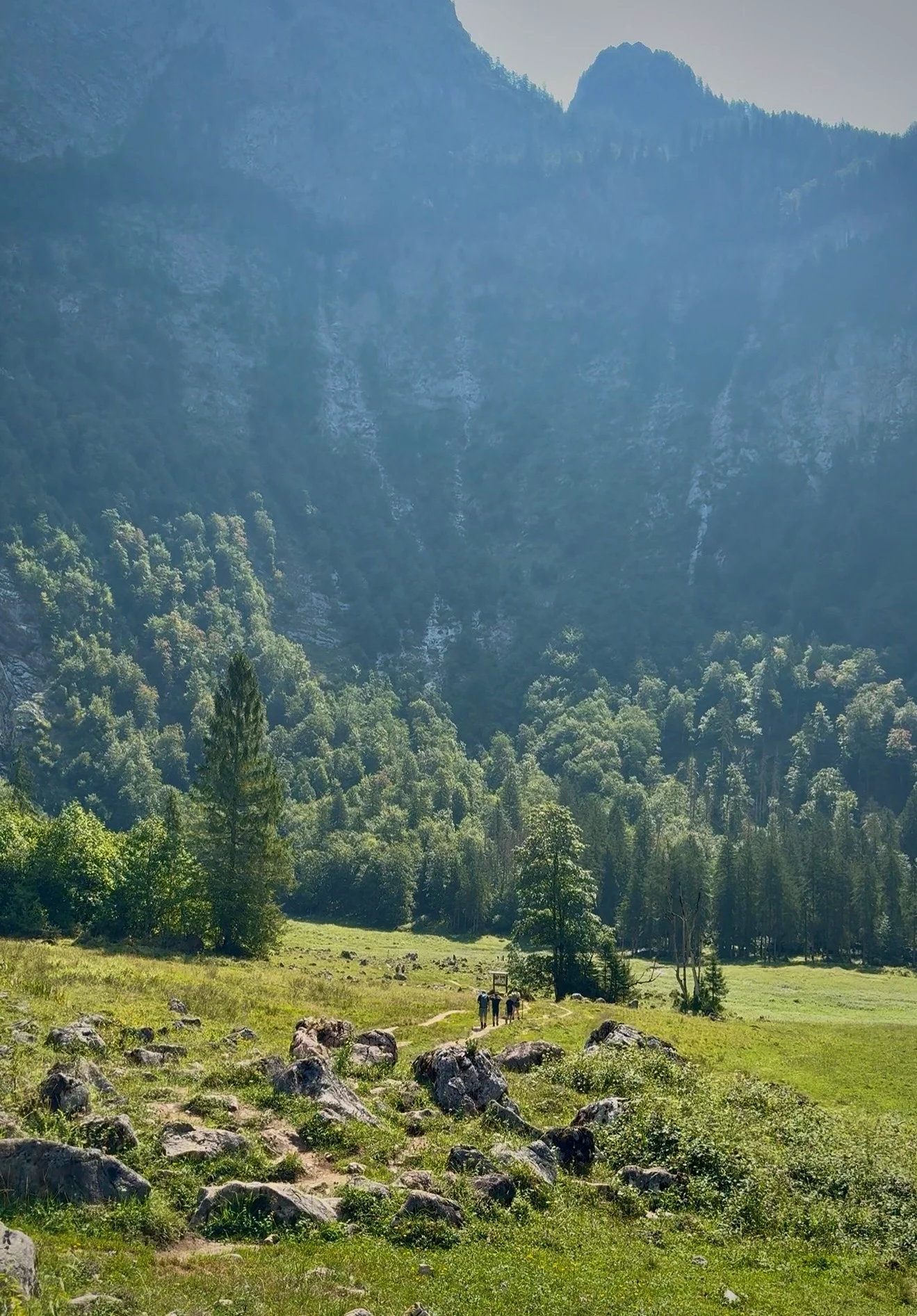
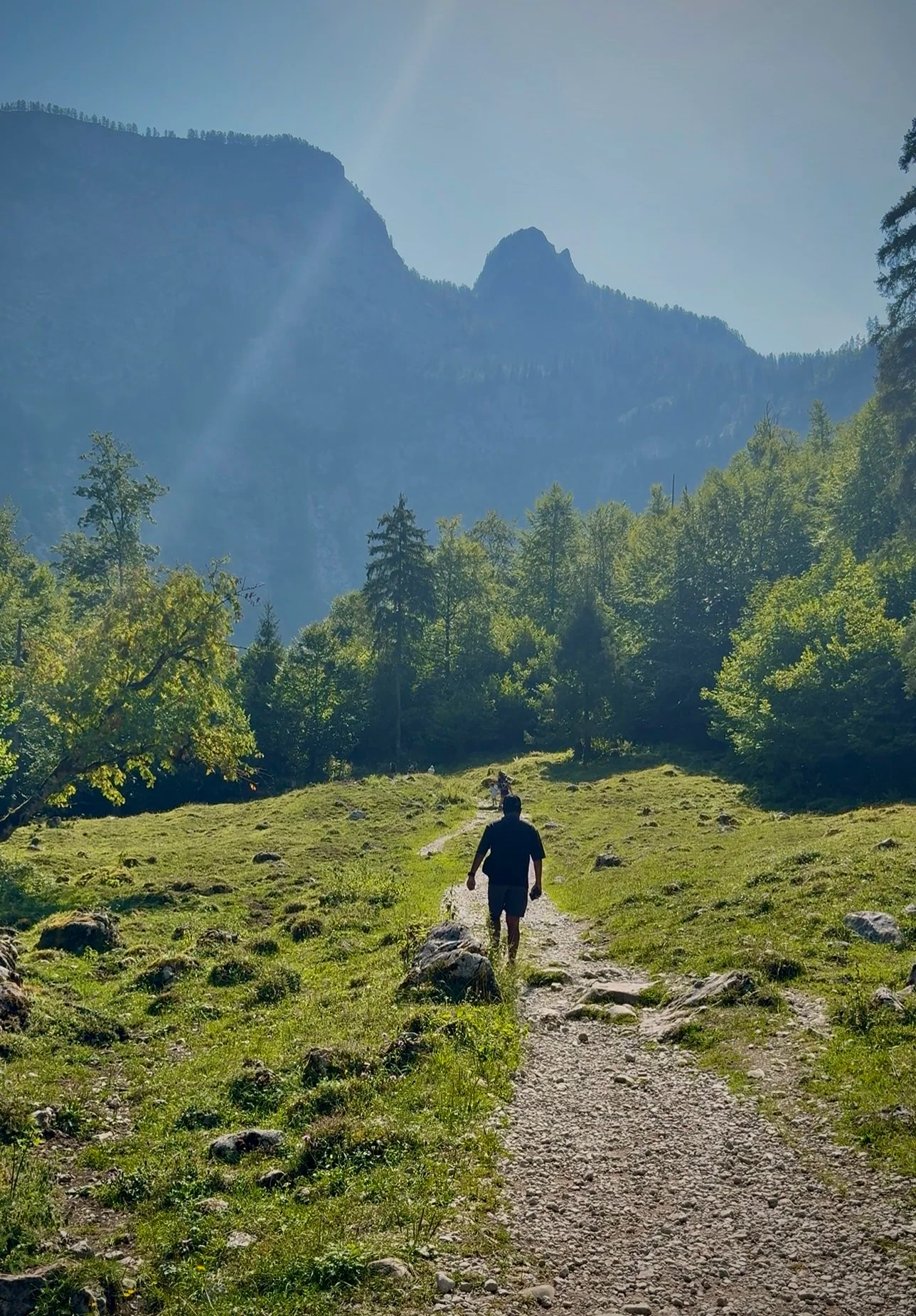
Beyond Fischunkelalm, Obersee disappears behind you and the walk becomes much more exposed. The shade around the lake gives way to open meadow, with the huge rock wall at the head of the valley becoming the main feature ahead. Röthbachfall descends over this wall and is generally described as Germany's highest waterfall.
The day was hot and humid, and by late morning the difference from the earlier section around Obersee was significant. Water, a cap, and sunglasses became much more important. Then hikers returning in the opposite direction started telling us that Röthbachfall was dry. We continued anyway, partly because we had already come this far and partly because we wanted to see it for ourselves.
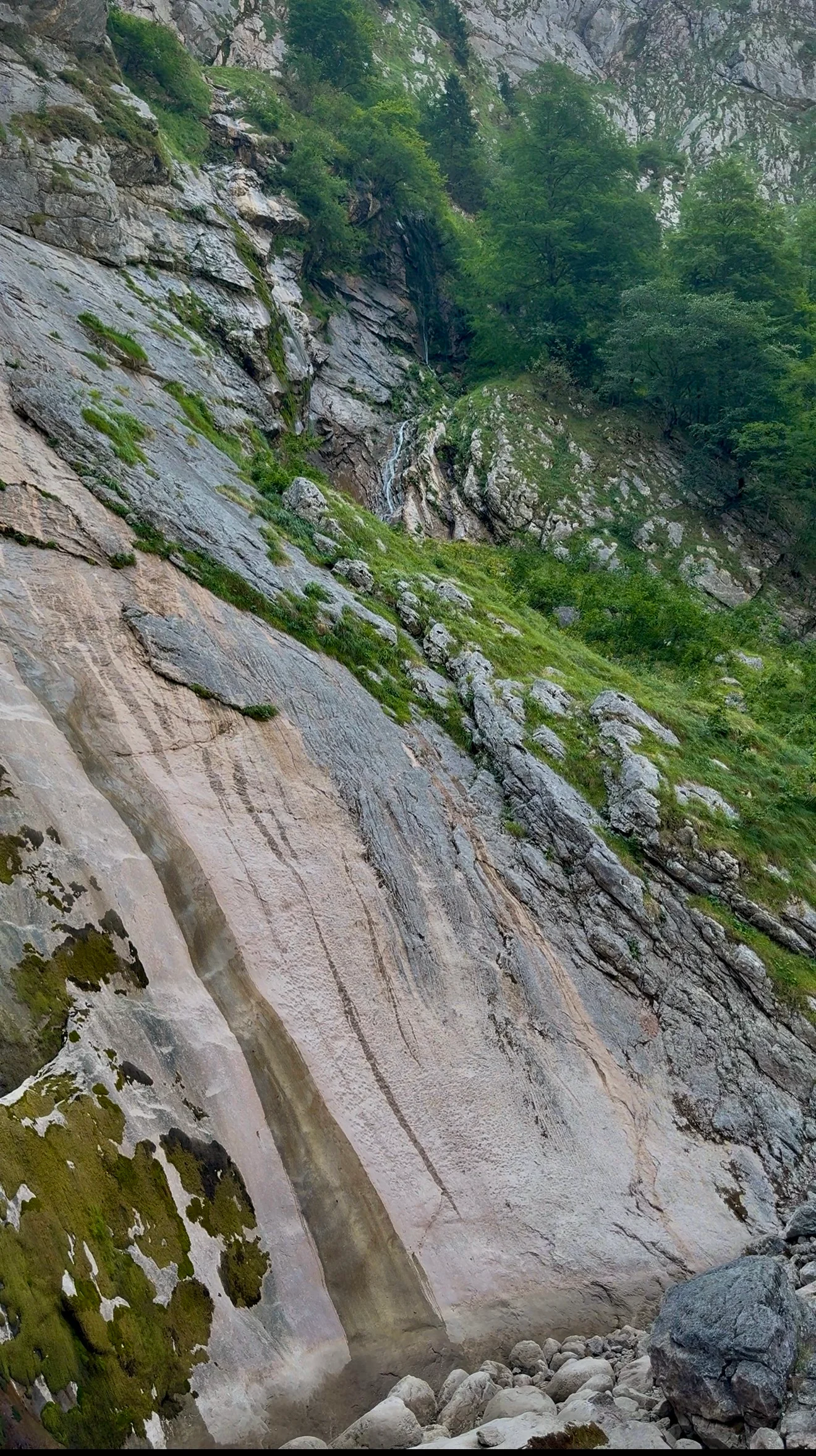
At around 11:30 am, we reached the usual area below the waterfall and finally understood what people meant. From there, the enormous pale rock face seemed almost dry. There was nothing resembling the strong white flow I had expected from photographs, and for a moment we genuinely wondered whether we were looking at the correct place. We were. We rested there for a while and could easily have turned back, but then we noticed several hikers continuing higher up the slope.
The climb we had not planned
Important: This rough climb was beyond the maintained route to the usual Röthbachfall viewing area. It was not part of the hike we had planned, and I do not recommend following it to reproduce our view towards Obersee.
It was obvious that what they were following was no longer the maintained route. There were no regular steps or clear walking path, only steep ground, rocks, exposed roots, and traces of where other people had climbed. We knew that before continuing, but curiosity won.
For roughly half an hour, we worked our way upwards. At times we used our hands for balance, and there were sections where we stopped briefly to work out the safest way through the loose ground and roots. From higher up, Röthbachfall came into clearer view. We could properly see the water flowing down the rock face and, more importantly, hear it. The waterfall finally had a presence that had been missing from the lower area.
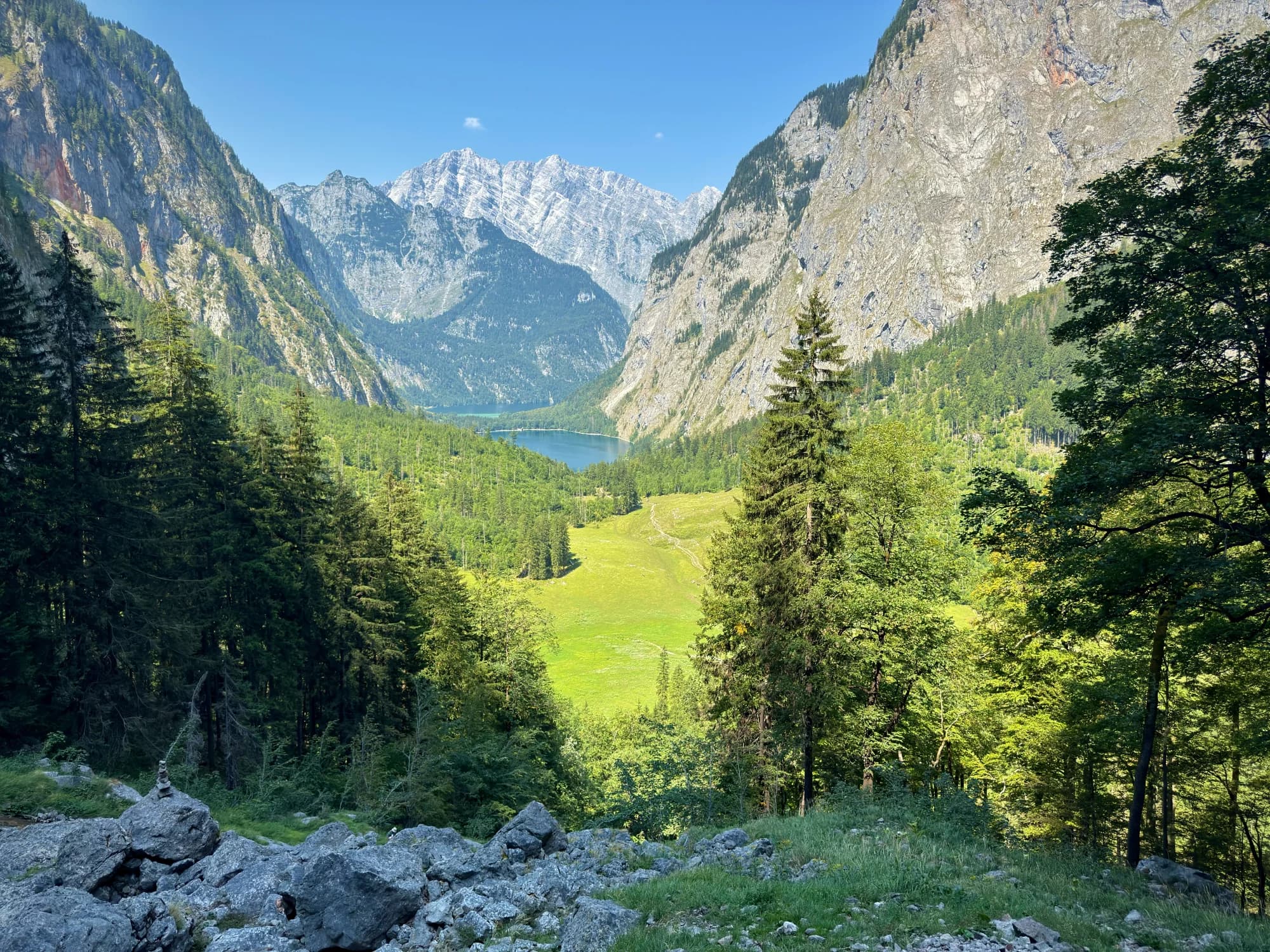
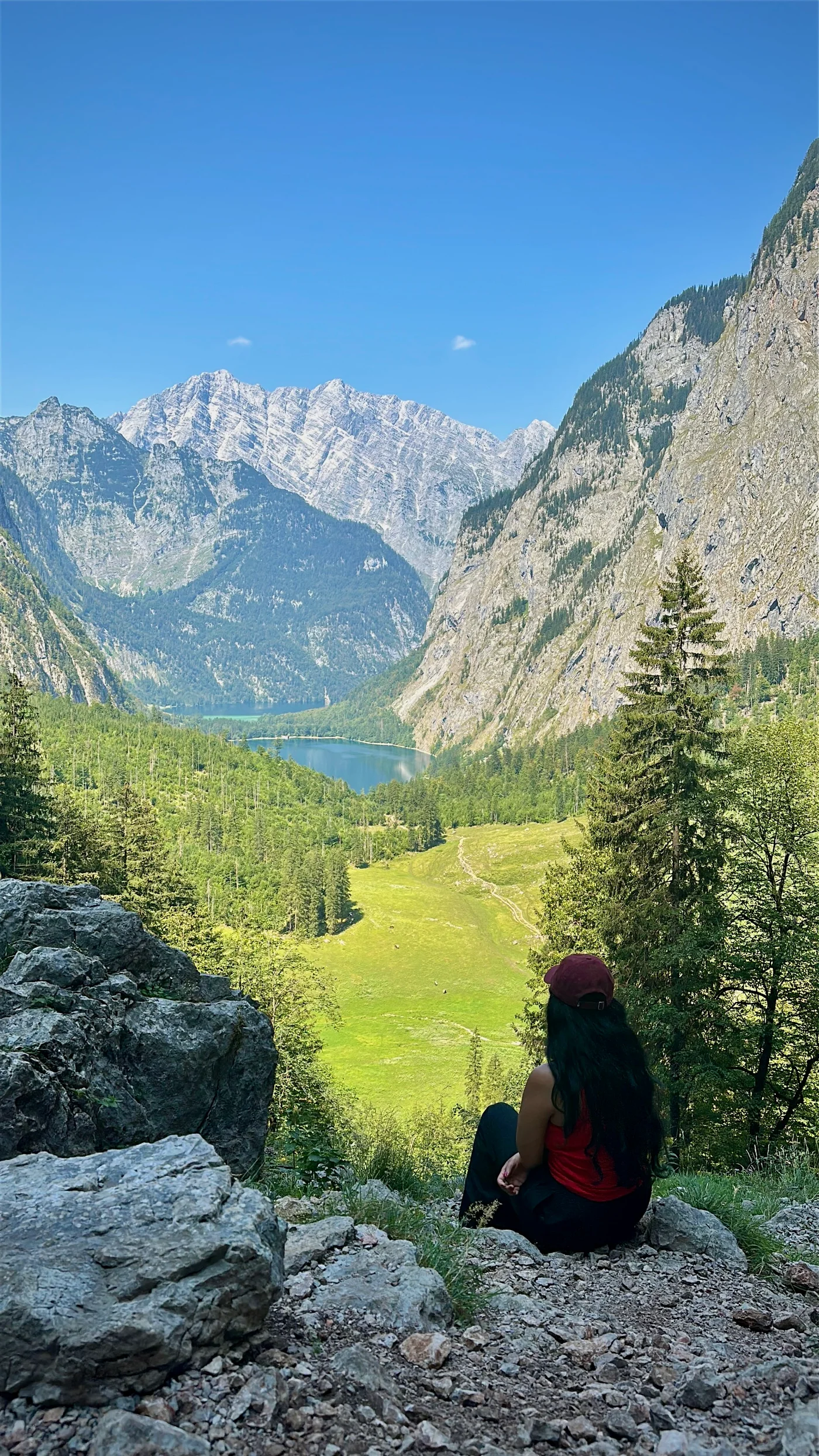
At some point we turned around, and that was when I noticed how far above Obersee we had climbed. Fischunkelalm was down in the meadow below us, and the lake looked surprisingly small from there. Only a few hours earlier we had been walking right beside it.
We had climbed up hoping for a better look at Röthbachfall, but I ended up liking the view behind us even more.
Getting down was harder than climbing up. Loose stones that had barely registered during the ascent suddenly mattered, exposed roots became awkward steps, and some sections were steep enough that we moved slowly and occasionally used our hands for support. Our legs were already tired by then, which made the descent feel longer than it probably was.
We also passed an older hiker heading upwards who seemed considerably more comfortable with the terrain than we felt coming down. It was a good reminder that confidence in the mountains has more to do with experience and fitness than age. By the time we finally reached easier ground again, I was relieved.
The route from Salet through Obersee and Fischunkelalm towards the normal Röthbachfall area is the excursion I would recommend. The rough ground we followed afterwards was not a casual extension of that maintained route.
Back to Fischunkelalm and on to St. Bartholomä
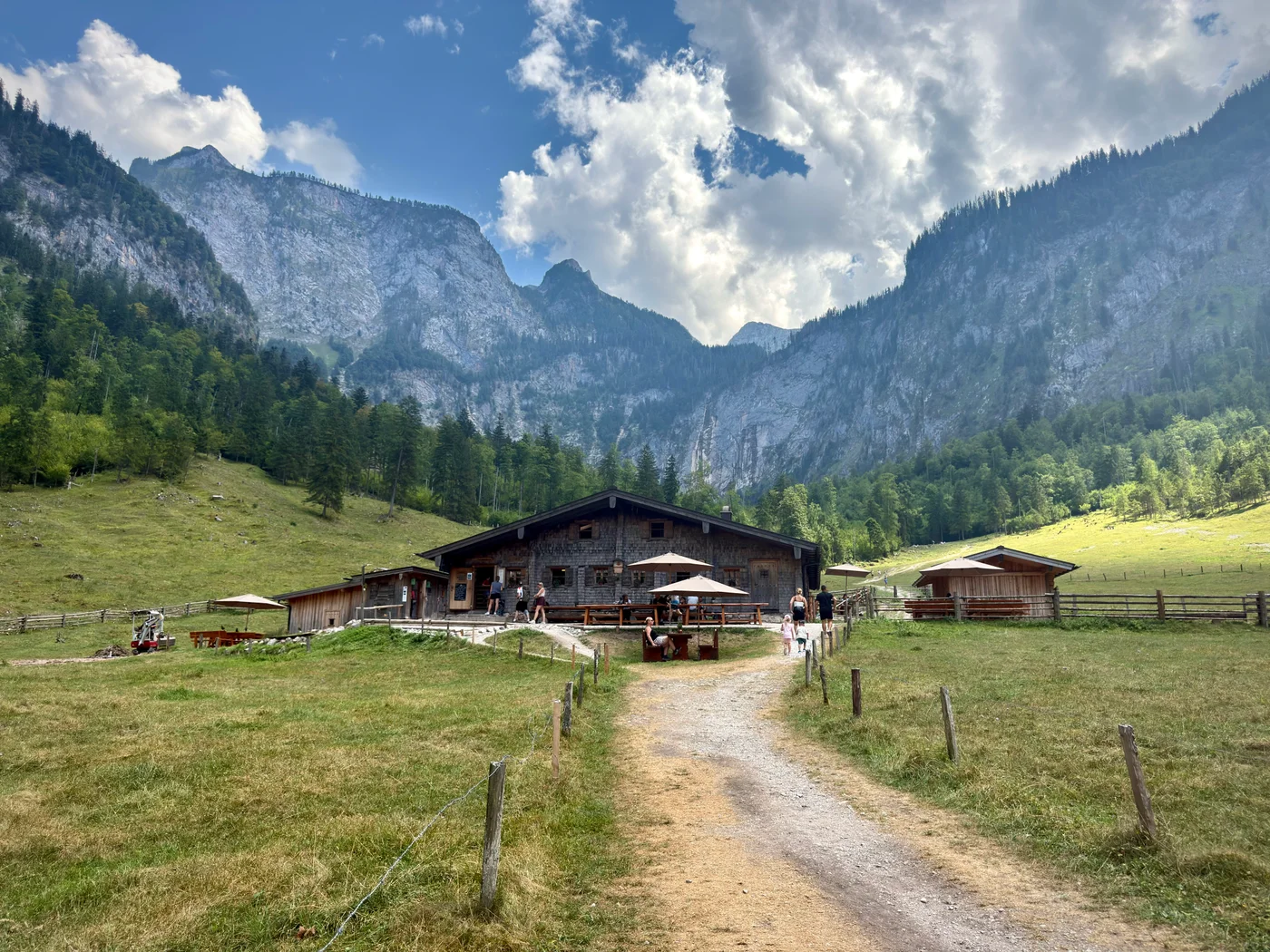
We returned to Fischunkelalm at around 1:45 pm, and this time there was no discussion about the buttermilk. We ordered it immediately. Cold, slightly sweet and raspberry-flavoured, it was exactly what I wanted after several hours in the heat. We sat for a while before continuing towards Obersee and Salet.
By afternoon, the paths were busier and there were far more people around the Obersee boathouse, which confirmed the main advantage of going directly to Salet first. Back at the boat landing, we joined the queue and travelled to St. Bartholomä, arriving at around 3:40 pm.
The atmosphere there contrasted sharply with Salet. Visitors were moving between the church, restaurant, lakeshore, and boat landing, and when rain began shortly after we arrived, even more people moved indoors. St. Bartholomä is a Baroque pilgrimage church and Königssee's best-known landmark, but the building itself is much smaller in person than its fame suggests.
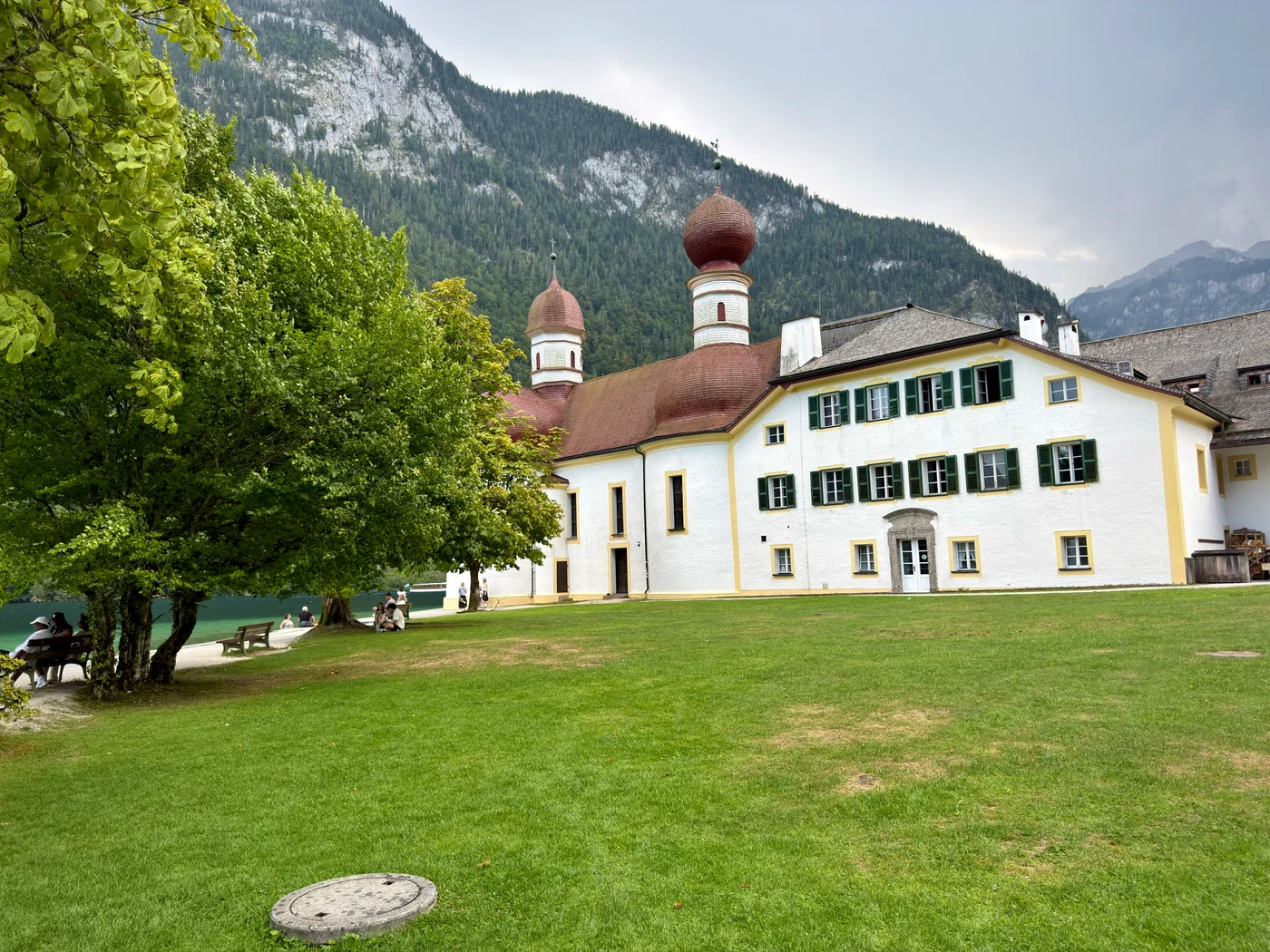
We went inside, where the interior felt relatively restrained and became crowded quickly because of the rain. I actually found the view outside more memorable than the church interior. From the boat, St. Bartholomä had stood out immediately. Once we were beside it, it looked much smaller than I had expected, especially with the mountains rising behind it.
The price of visiting St. Bartholomä late
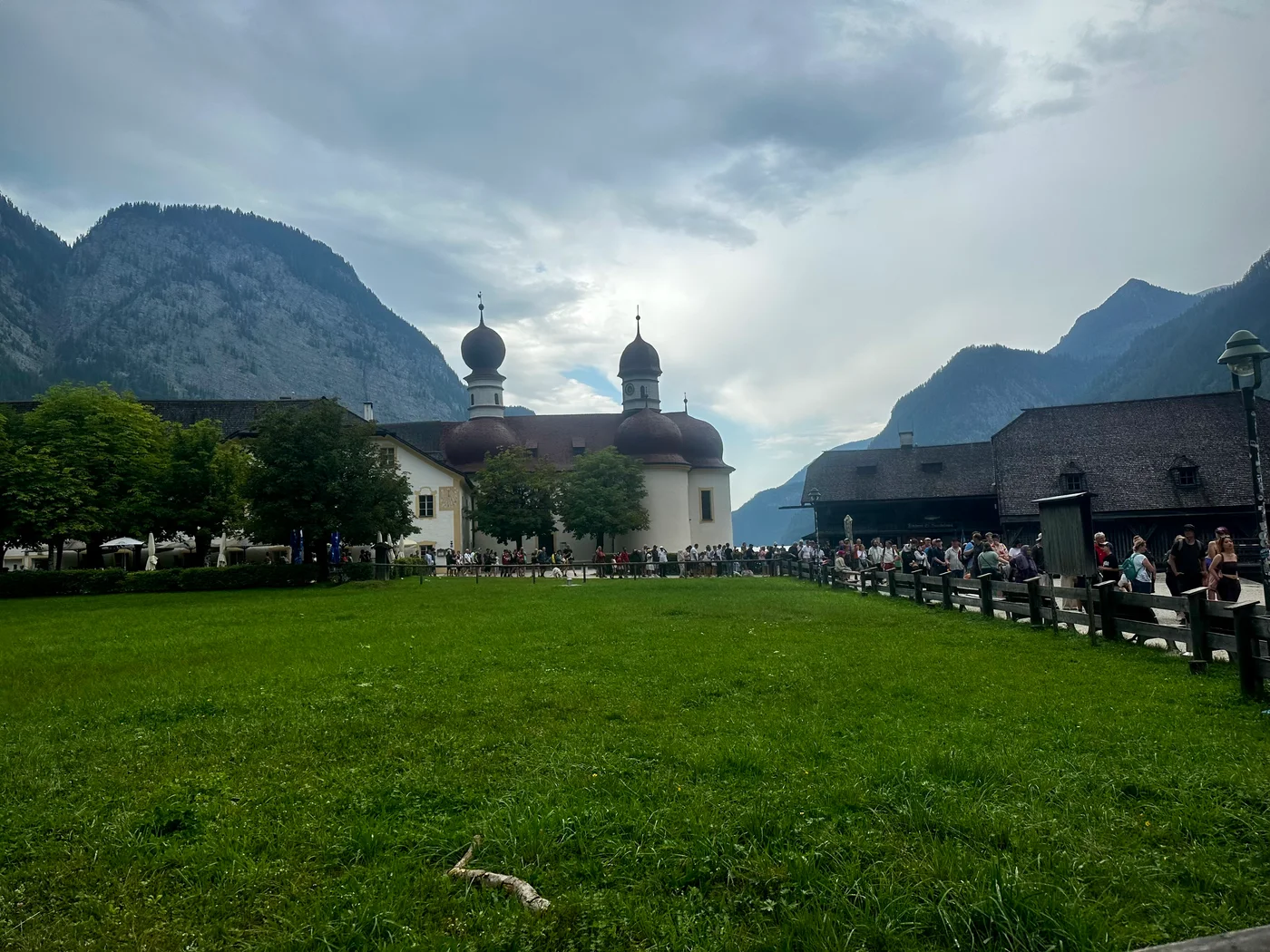
The return line was enormous. It stretched well beyond the immediate landing area, and after the long hike it was not exactly what we wanted to see. Part of the problem was timing. Boats arriving from Salet were already carrying passengers, so only a limited number of people could board at St. Bartholomä unless more space became available. As the afternoon progressed, additional boats also arrived to move people back towards Königssee.
Thankfully, the queue moved faster than we expected. I would still go to Salet first if I did the day again because Obersee was much quieter in the morning and we could do the longest walk before the hottest part of the afternoon. I would just expect a possible wait at St. Bartholomä on the way back.
By the time we returned to Seelände at around 5:30 pm, the bright morning sky had disappeared behind low cloud and the lake looked much darker beneath the mountains. After such a long day, we wanted a gentler pace the following morning, and Ramsau gave us exactly that.
Ramsau to Hintersee through Zauberwald
We had considered Jenner, but another demanding mountain day did not appeal to us. Instead, we took Bus 840 from near our hotel to Berchtesgaden Hauptbahnhof, changed to Bus 846 and got off at Ramsau Kirche, even though the second bus could have carried us directly towards Hintersee. The Berchtesgaden Guest Card provided by our hotel covered both local bus journeys and also offered discounts at selected attractions, although transport was the benefit we used.
The church itself is one of the most recognisable views in the Berchtesgaden region, but what I enjoyed more was how naturally the route continued from there. We followed the Ramsauer Ache westwards, with clear water moving around pale stones and beneath small bridges as the village gradually disappeared behind us. Compared with the previous day, the walk required very little concentration. We could simply walk and look around rather than constantly thinking about the trail beneath our feet.
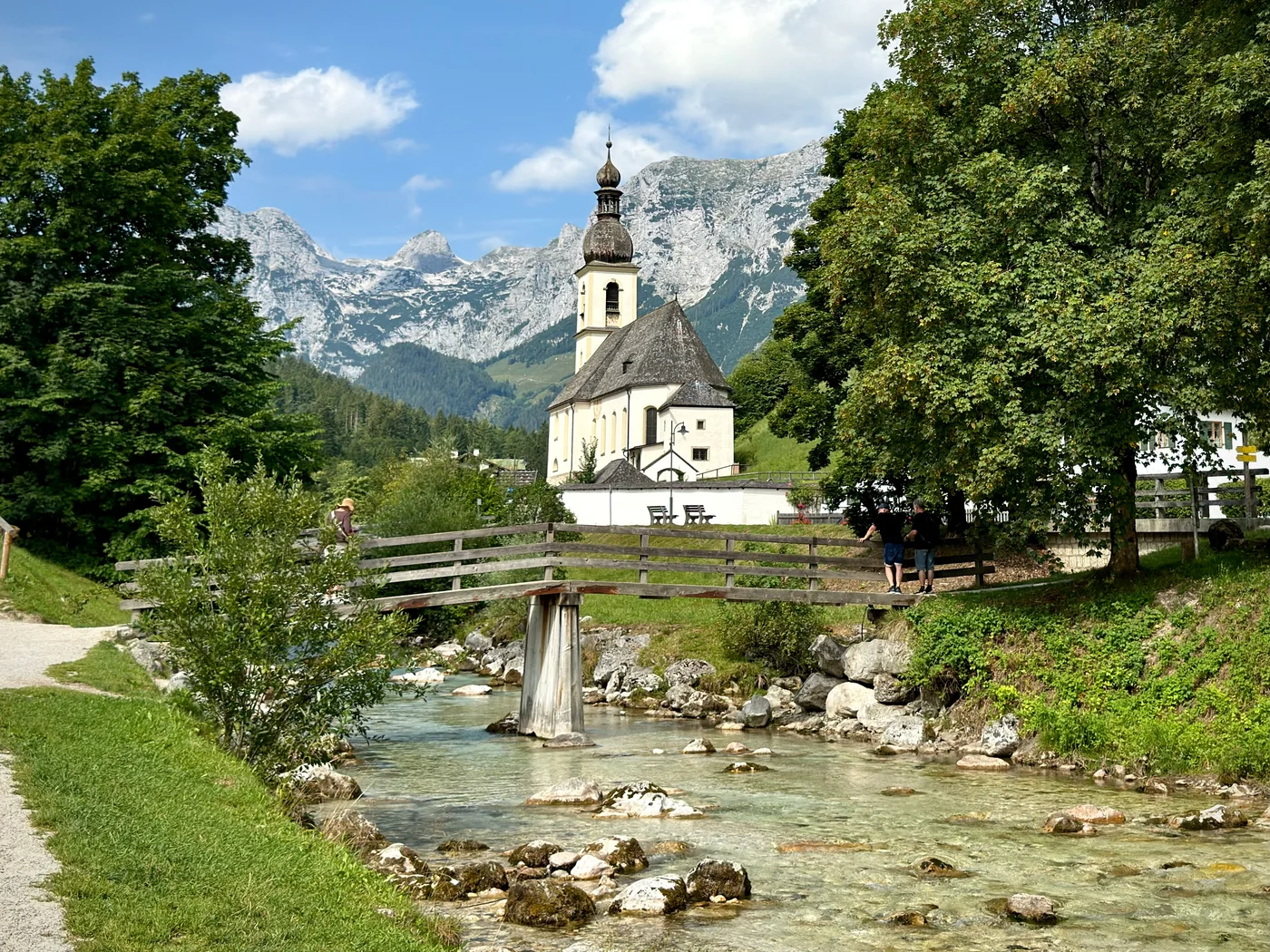
Then the forest changed. Zauberwald, or Enchanted Forest, owes much of its unusual appearance to a massive rockfall around 3,500 years ago. Huge blocks of rock were deposited through the valley, and the Ramsauer Ache now works its way between them. I hadn't known about the rockfall before coming here, and it explained why there were such enormous boulders scattered throughout the forest.
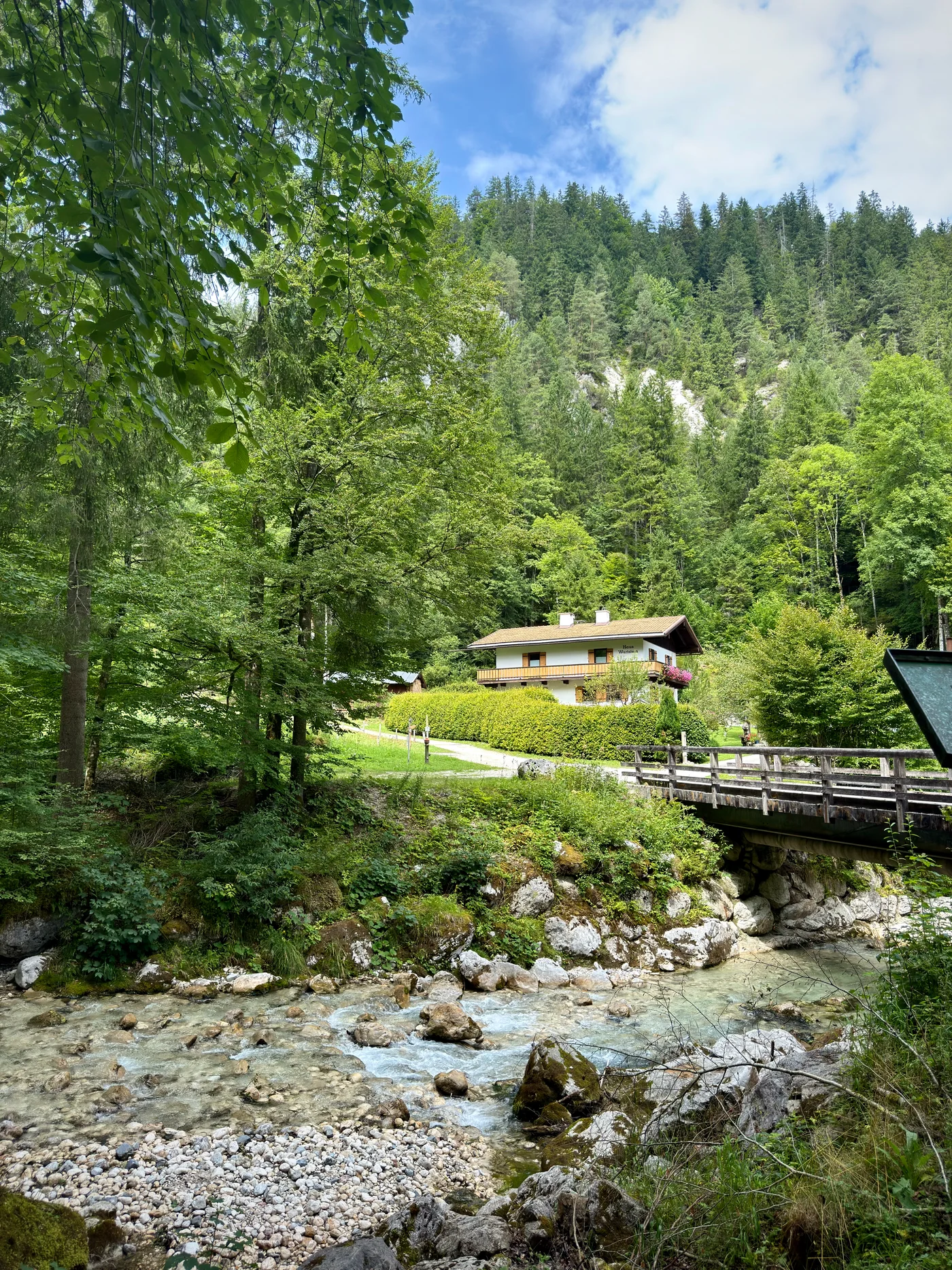
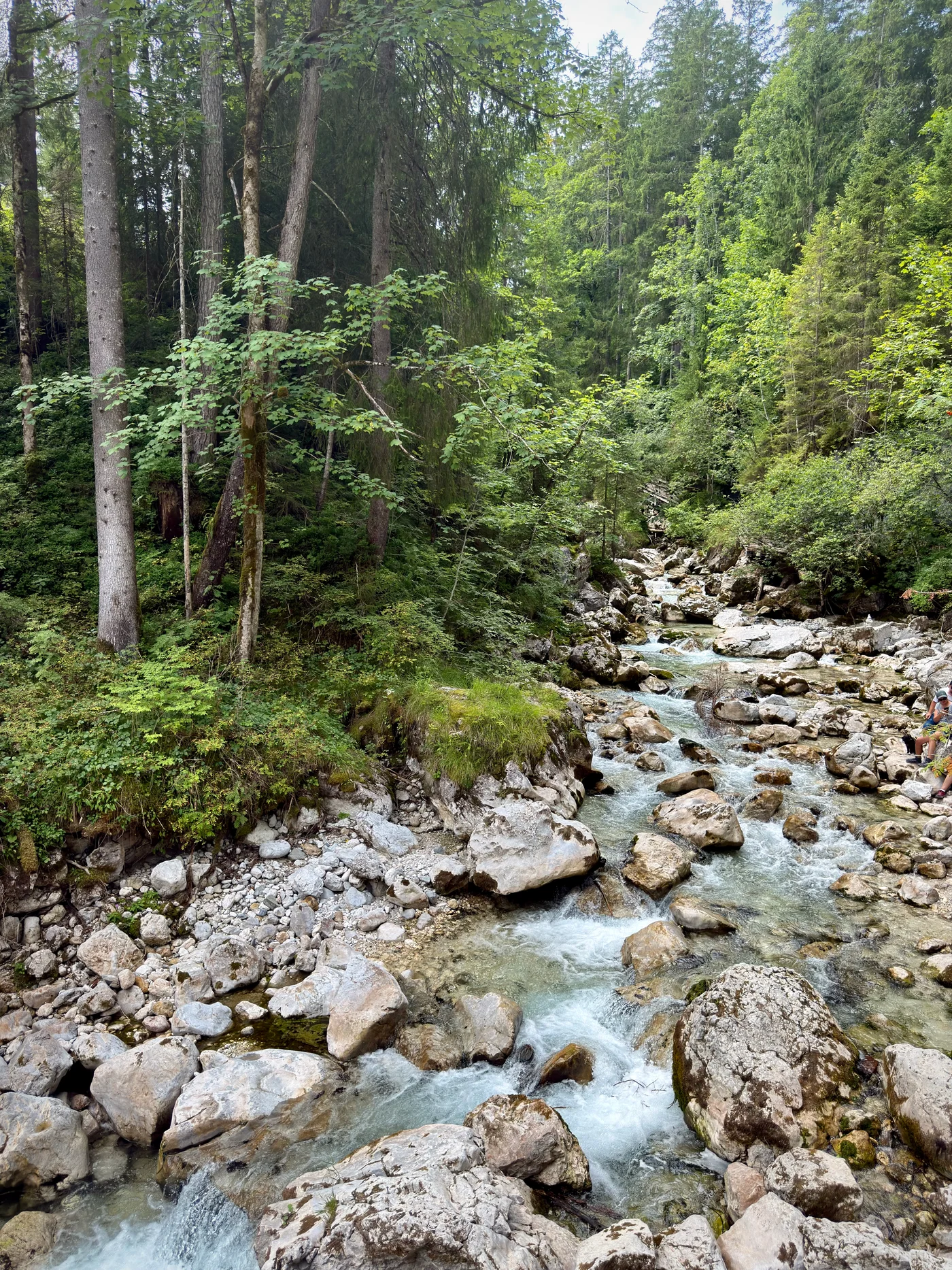
Tree roots had grown around moss-covered rocks, ferns filled the spaces between them, and the river repeatedly disappeared behind boulders before reappearing in faster, noisier sections. This was probably my favourite part of the Ramsau walk. We weren't really walking towards a particular viewpoint, but I kept stopping anyway. Sometimes it was the river squeezing between huge rocks, sometimes the moss-covered boulders, and sometimes just the sound of the water getting louder as we came around a bend.
We reached the Zauberwald section at around 12:30 pm and eventually continued towards Hintersee.
Hintersee as the end of the walk
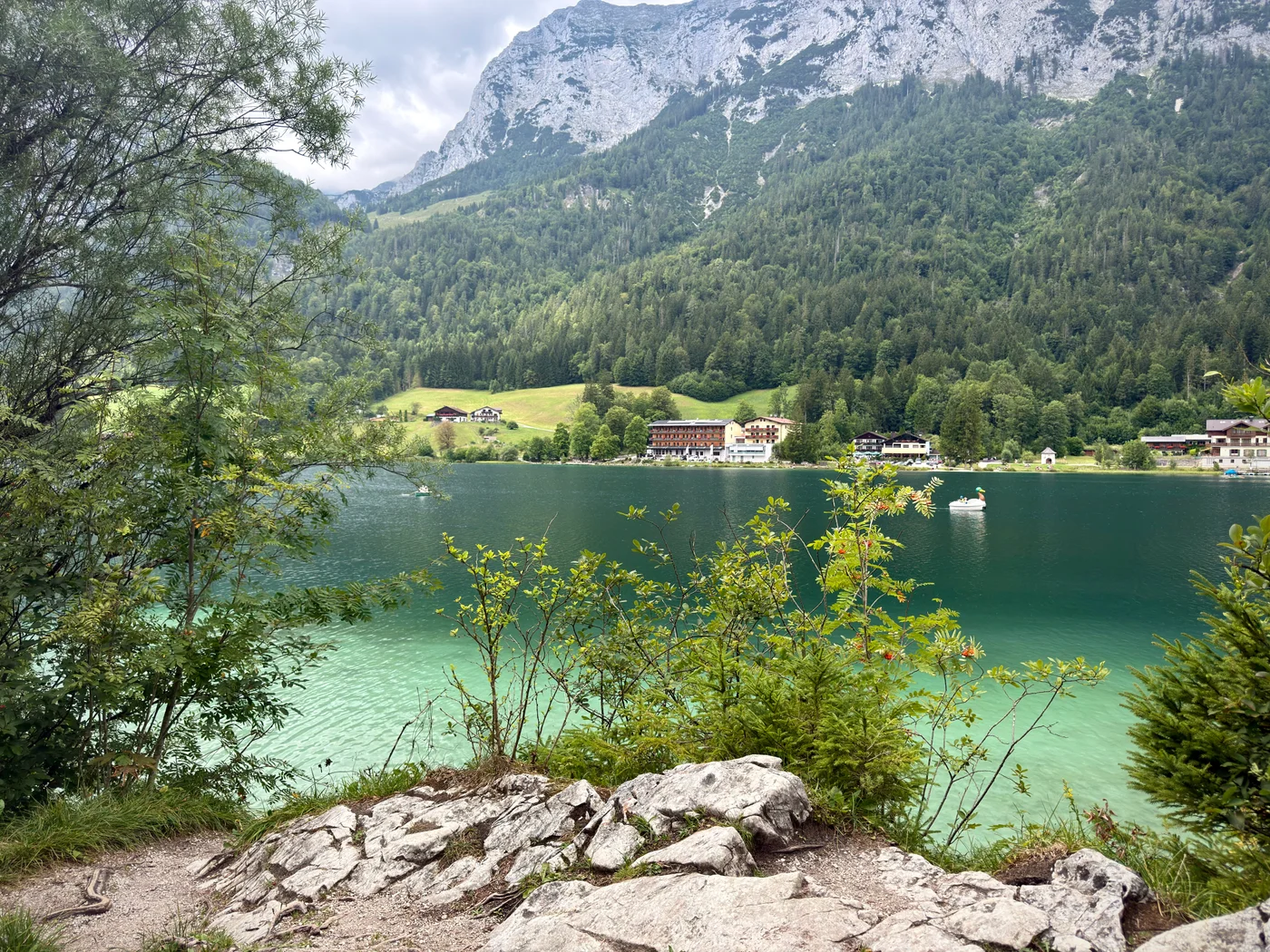
Coming out of Zauberwald and reaching Hintersee opened the landscape around us. The forest had been enclosed, shaded, and noisy with running water, while Hintersee was broad and bright, with mountains rising behind the lake and far more people around the shore. People were swimming, small boats were out on the water, and families were sitting beside the lake.
We decided to walk the full loop, an almost flat circuit of approximately 2.7 km that usually takes about an hour before stops. There was no particular objective now, no waterfall to reach and no difficult trail waiting ahead. We walked around the shore, stopped at several points, and eventually sat near the water for a while. After the previous day, the slower pace was welcome.
I'm glad we got off at Ramsau Kirche instead of staying on the bus all the way to Hintersee. The walk along the Ramsauer Ache and through Zauberwald ended up being my favourite part of the route, and reaching the lake afterwards felt like a natural place to slow down. If we had taken the bus directly there, we would have missed most of what I liked about this day.
Malerwinkel: finally seeing Königssee from above
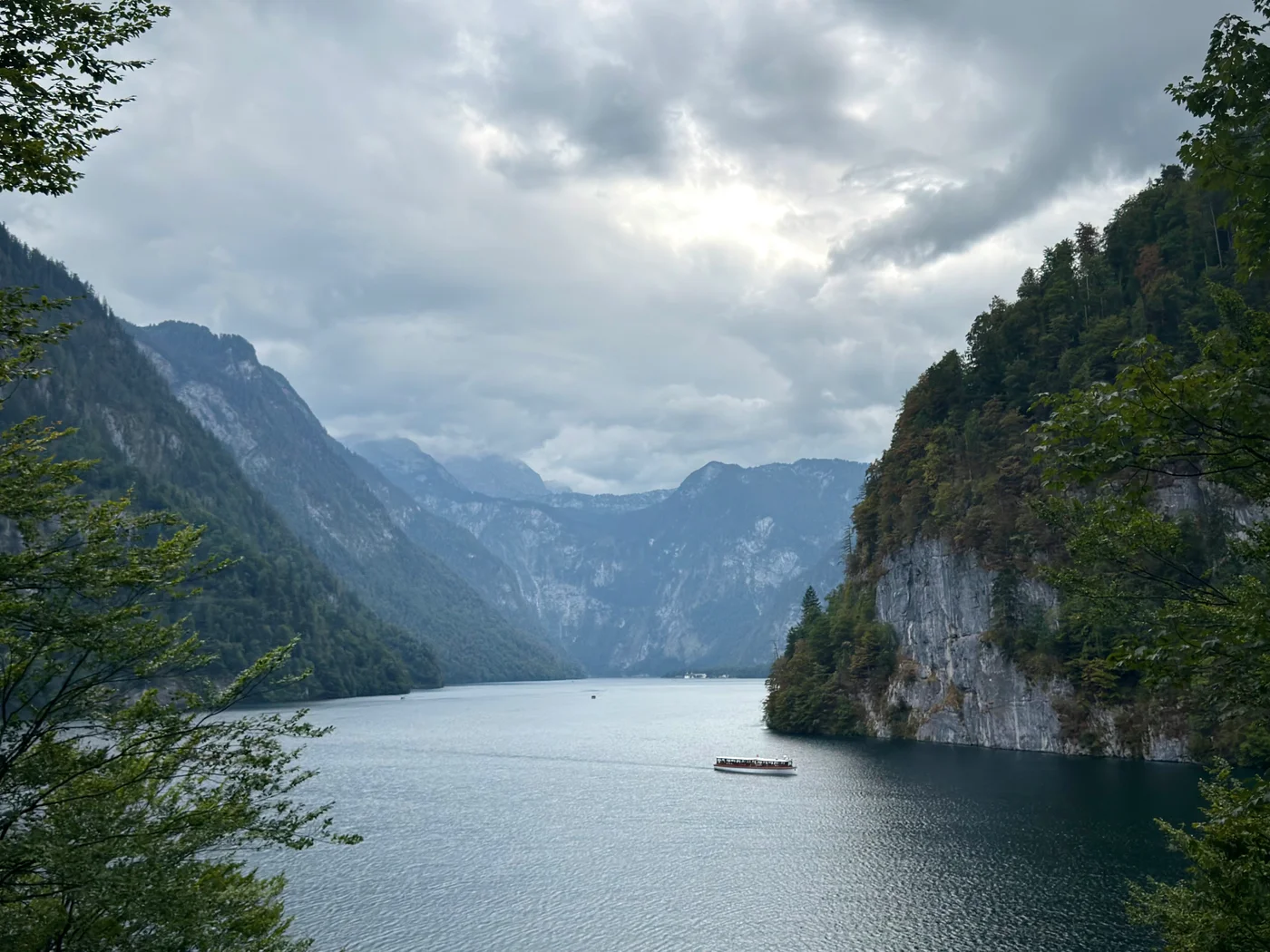
We reached the Königssee area again at around 3:30 pm and walked to Malerwinkel. Until then, we had mostly seen Königssee from water level, either from the shore or the boat. From Malerwinkel, I could finally see how the lake actually sits between the mountains. From above, Königssee stretches away between steep mountain walls, with St. Bartholomä sitting far in the distance. We walked back along the same path after visiting the viewpoint rather than completing the full circular route.
The weather transformed the view from what we had seen the previous day. The morning boat journey had been clear and bright, while now low cloud hung over the mountains, sections of the upper ridges had disappeared into grey, and the water had darkened. A boat moving below looked tiny against the scale of the lake.
Looking down from there also helped me make sense of the previous day. St. Bartholomä was tiny in the distance, and I could finally see how far the boat had taken us across the lake. A small boat moving below us looked even smaller from up there.
A livelier Seelände
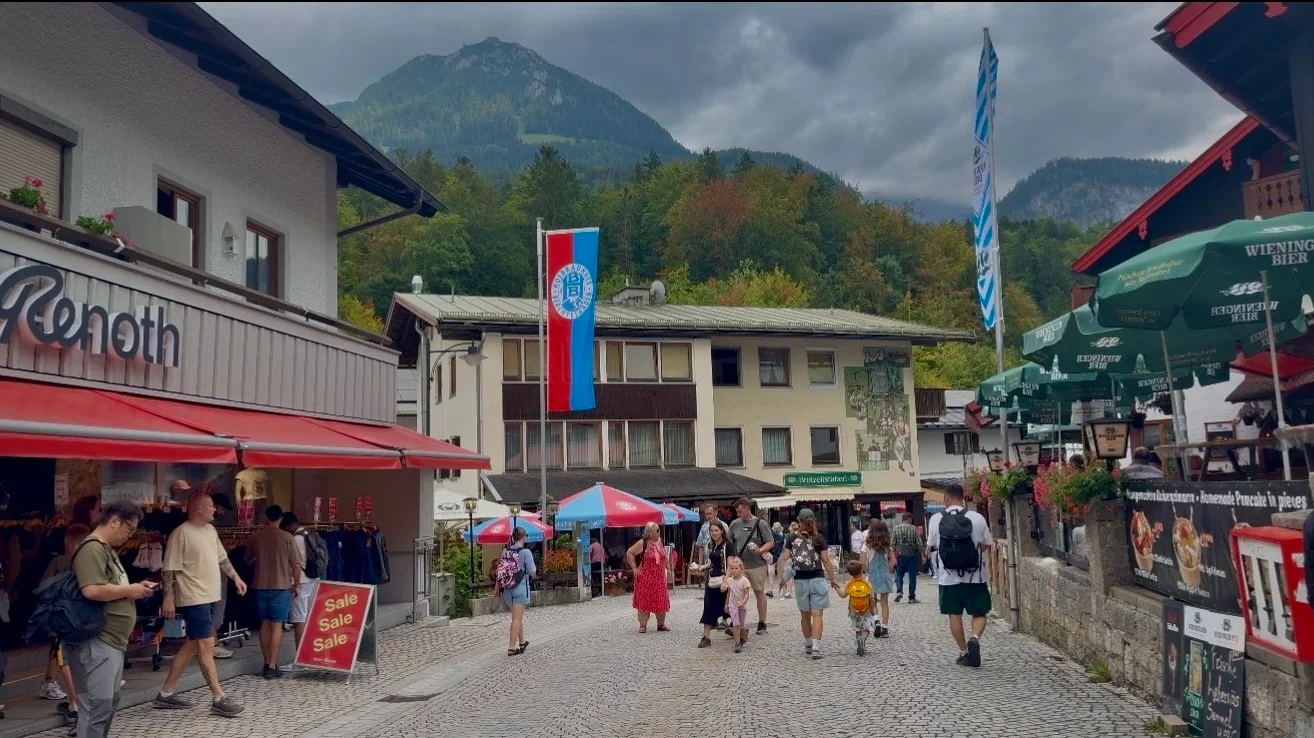
Coming back down from Malerwinkel brought us to a very different Seelände from the one we had seen on our first evening. This time the shops were open, restaurants were busy, and people were still walking around the waterfront.
We stopped at Brotzeitstüberl because we were hungry and finally tried Apfelstrudel with ice cream, along with pizza and beer. Then it started raining again. We stayed anyway, walked through a few shops afterwards, bought some souvenirs and somehow ended up eating ice cream in the rain.
When I think about Königssee now, the boat ride isn't the first thing that comes back to me. I remember putting my feet into the cold lake on our first evening, seeing St. Bartholomä slowly appear from the boat, the almost-dry Röthbachfall, climbing much higher than we had planned, and ordering that raspberry buttermilk the second we got back to Fischunkelalm.
I also remember how different the lake looked each time we returned. Quiet and almost empty in the evening, bright the next morning, dark under the rain, and finally stretched out below us from Malerwinkel.
I'm glad we gave Königssee more than one day. Not because we managed to see everything, because we didn't, but because we had enough time for some of the unplanned parts too. Those are probably the ones I remember best.