Helsinki, Finland
Our trip to Helsinki was a workation rather than a regular city break. We were not spending full days sightseeing, so we explored the city around our work schedule.
Helsinki turned out to be well suited to this kind of trip.
The central areas are walkable, public transport is easy to use, and many attractions can be visited within a few hours. We could explore a neighbourhood, visit a museum or stop at a market without needing to keep an entire day free.
We visited in March, when the weather was cold and the city was quieter. The cold made indoor places such as market halls, museums, bookstores, libraries and cafés an important part of our experience.
This guide is not a fixed Helsinki itinerary. It is for travellers who want to explore the city at a slower pace, especially while working during part of the trip.
Is Helsinki Good for a Workation?
Helsinki worked well for us because it was easy to explore in smaller sections.
Many of the main attractions are close to the city centre, and you do not need to spend a lot of time travelling between them. Places such as Senate Square, Market Square, Helsinki Cathedral, Uspenski Cathedral and the Old Market Hall can be combined in one walk.
Other areas, including Punavuori and Katajanokka, are also easy to explore without a strict plan.
The city is particularly suitable for travellers who enjoy:
- Architecture and design
- Museums and libraries
- Coffee shops and market halls
- Waterfront walks
- Quiet neighbourhoods
- Sightseeing without rushing
The main disadvantage is the cost. Helsinki is more expensive than many other European cities, especially for accommodation and food. A workation can still be manageable if you choose accommodation with a kitchen and mix restaurant meals with bakeries, cafés and market halls.
Arriving in Helsinki by Ferry from Tallinn
We travelled to Helsinki by ferry from Tallinn. The journey took around three hours and was a comfortable way to travel between the two cities.
The check-in process was straightforward. We used a QR code, found our seats and relaxed during the journey.

Arriving by sea gives you a different first view of Helsinki. Instead of entering through an airport or railway station, you approach the city across the Baltic Sea and arrive close to the waterfront.
Combining Tallinn and Helsinki also makes sense because the ferry journey is simple. If you are already visiting Tallinn, adding Helsinki can give you a very different experience without taking another flight.
Where to Stay for a Helsinki Workation
We stayed in Punavuori, which is part of the Helsinki Design District.
Punavuori was a good base because it felt residential but was still close to the main attractions. We could leave our accommodation after work and immediately find cafés, independent shops, galleries and interesting streets.

The area was quieter than the streets around Market Square and Helsinki Cathedral. At the same time, it did not feel disconnected from the centre.
For a workation, staying in or near Punavuori gives you a useful balance:
- A quieter atmosphere
- Cafés and shops nearby
- Easy access to the city centre
- Interesting streets for short walks
- Several design-related attractions within reach
You do not need to stay directly beside the major landmarks to explore Helsinki easily.
Places You Can Visit Around Your Workday
Some Helsinki attractions are easy to visit before work, after work or during a longer break. These places do not require most of the day.
Punavuori and the Design District
Punavuori is one of the easiest areas to explore without a fixed route.
The neighbourhood has independent shops, galleries, cafés and residential streets. Helsinki's design identity is visible in shop interiors, furniture, lighting and even ordinary public spaces.
You can spend an hour walking through the area or stay longer if you want to visit the Design Museum.
Senate Square and Helsinki Cathedral
Senate Square is one of the most recognisable places in Helsinki.
The white Helsinki Cathedral stands above the square at the top of a wide staircase. Walking up the steps gives you a better view of the surrounding buildings and streets.

The cathedral is close to Market Square, the Old Market Hall and the waterfront, so you can combine several major sights in a short period.
Uspenski Cathedral and Katajanokka
Uspenski Cathedral looks completely different from Helsinki Cathedral.
Its red-brick exterior, green roof and position above the harbour make it easy to recognise from a distance.

From here, you can continue into Katajanokka, a quieter residential neighbourhood known for its Art Nouveau architecture.

Katajanokka is ideal for a short walk because you do not need tickets or a planned route. The main reason to visit is to notice the buildings, decorative façades and small architectural details.
Esplanade Park
Esplanade Park runs through central Helsinki and connects several shopping streets, cafés and waterfront areas.

We visited in March, so it did not look as green as it does during summer. Even then, people were using it for short walks and sitting on benches.
It is not somewhere you need to plan separately. You will probably pass through it while walking between other attractions.
Academic Bookstore and Stockmann
The Academic Bookstore is a good stop if you enjoy books, architecture or simply browsing indoors.

The building has a spacious interior and a café, so it is easy to spend time here without feeling rushed.
Stockmann department store is nearby and can be useful for shopping, browsing or taking a break from the cold.
These are not major tourist attractions, but they fit well into a workation because they are central and do not require advance planning.
The Design Museum
Helsinki has a strong design identity, and the Design Museum helps explain how design influences everyday life in Finland.

The collection includes furniture, fashion, household products and visual communication.
What I found most interesting was the focus on practical objects. Many of the items were designed to be useful, durable and simple rather than only decorative.
The museum gave more meaning to the details we had already noticed around Helsinki. Public spaces felt organised, interiors were uncluttered, and ordinary objects often looked carefully considered.
You can visit the museum in a few hours, which makes it easy to combine with a walk through Punavuori.
Oodi Central Library
Oodi was one of my favourite places in Helsinki.

It is often described as Helsinki's living room, and that description makes sense once you visit.
Oodi is not only a place to borrow books. People use it to read, work, study, meet others, spend time with children or simply sit near the large windows.
The building feels modern and active without becoming noisy. Its open spaces and natural light make it comfortable to spend time inside, especially during colder weather.
For travellers on a workation, Oodi is particularly interesting because it shows how seriously Helsinki treats public spaces.
I would recommend visiting even if you are not usually interested in libraries.
The Old Market Hall
The Old Market Hall was one of the most useful and enjoyable places we visited.
It is located beside the harbour and is easy to combine with Market Square, Senate Square and the ferry to Suomenlinna.

Inside, you will find stalls selling fish, bread, pastries, sandwiches, snacks and Finnish specialities.
We tried an open-faced sandwich with shrimp and crayfish and had our first Finnish coffee here.
We returned more than once because the market hall was warm, central and convenient. It worked equally well for a quick snack and a longer break.
For a workation, places like this are useful because you do not always have time for a long restaurant meal.
Market Square and Salmon Soup
Market Square is located beside the harbour and is one of the livelier parts of central Helsinki.
There were stalls selling food, souvenirs and local products.

We tried salmon soup here, which became one of the most memorable foods from the trip.
The soup was creamy, warm and filling. After walking near the waterfront in March, it was exactly the kind of food we wanted.
Market Square is also the starting point for ferries to Suomenlinna, so you can stop here before or after visiting the island.
Visiting Suomenlinna During a Workation
Suomenlinna is one place that needs more than a short break.
The sea fortress is spread across several islands and can be reached by ferry from Market Square.

The journey is short, but Suomenlinna feels very different from central Helsinki.
The island has old fortifications, walking paths, coastal views and open landscapes. We explored it slowly rather than trying to visit every museum or historical building.
For us, the main experience was walking through the island, seeing the fortress walls and spending time near the sea.
How much time do you need for Suomenlinna?
Allow around two to three hours for a relaxed walk. You may need longer if you plan to visit museums or stop for food.
Can you visit Suomenlinna after work?
It depends on the season and your work schedule, but I would not try to squeeze it into a short evening.
It is better to visit when you have a free morning, a weekend or a longer block of time.
Is Suomenlinna worth visiting in March?
Yes, but you need warm clothing.
The wind near the water made it feel colder than central Helsinki. The advantage was that the island felt quieter and less crowded.
Johanneksen Church
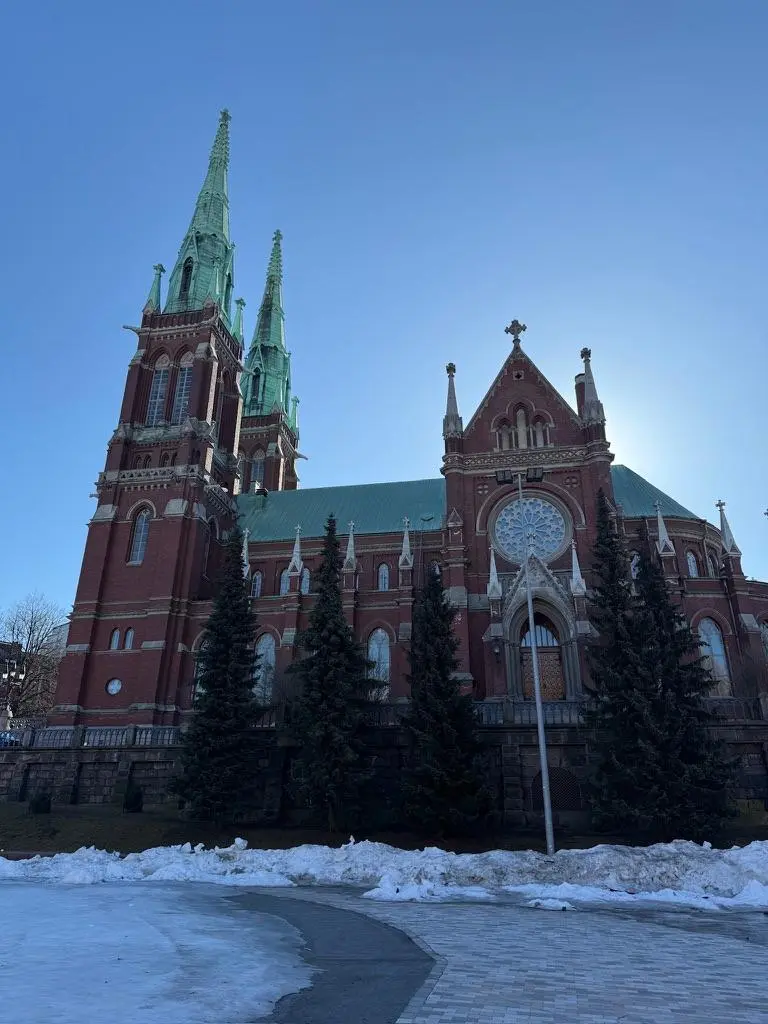
Johanneksen Church is located in a residential part of Helsinki and looks very different from both Helsinki Cathedral and Uspenski Cathedral.

Its tall Gothic Revival towers stand out above the surrounding streets.
It is worth adding if you are already exploring Punavuori or the Design District. I would not cross the entire city only to visit it, but it fits naturally into a walk through the area.
This is the kind of place that works well during a workation because you can see it without changing your entire schedule.
Coffee and Food in Helsinki
Coffee and food stops became an important part of how we explored Helsinki.
We visited Andante Coffee for coffee and pastries. It had a comfortable interior and worked well as a break between walking around the central neighbourhoods.

The Old Market Hall was our most convenient option for quick meals and snacks.
What to try in Helsinki
Salmon soup
A warm and filling meal that is especially good during colder weather.
Open-faced sandwiches
We tried one with shrimp and crayfish at the Old Market Hall.
Coffee
Coffee shops are easy to find throughout Helsinki and became part of our daily routine.
Pastries
A practical choice for breakfast or a short afternoon break.
Helsinki can be expensive, so market halls, cafés and bakeries are useful alternatives to eating every meal in a restaurant.
What Is Helsinki Like in March?
March is a quiet time to visit Helsinki.
The weather was cold, especially near the harbour and on Suomenlinna. A warm coat, layers and something that protects you from the wind are important.
The colder weather also changes the way you experience the city.
We spent more time in libraries, museums, bookstores, cafés and market halls than we might have during summer. These indoor places did not feel like backup plans. They became some of the best parts of the trip.
March may not be the best choice if you want green parks, long outdoor evenings and warm weather.
It can still be a good time to visit if you prefer fewer crowds and enjoy combining outdoor walks with cultural and indoor attractions.
How to Plan Helsinki Around Work
Instead of creating a strict day-by-day itinerary, group attractions according to how much free time you have.
When you have one hour
- Walk through Punavuori
- Visit Senate Square
- Walk around Katajanokka
- Browse the Academic Bookstore
- Stop at the Old Market Hall
- Walk through Esplanade Park
When you have two to three hours
- Visit the Design Museum
- Explore Oodi Central Library
- Combine Market Square, Helsinki Cathedral and Uspenski Cathedral
- Walk through the Design District and visit Johanneksen Church
When you have half a day
- Visit Suomenlinna
- Explore several neighbourhoods on foot
- Combine a museum with a longer café or market stop
This approach gives you flexibility. You can decide what to visit according to your workload, the weather and how much energy you have.
What Should You Prioritise?
When time is limited, I would prioritise:
- Suomenlinna for coastal scenery and a different side of Helsinki
- Oodi Central Library for modern Finnish public design
- Punavuori and the Design District for neighbourhood walks
- Old Market Hall for easy access to local food
- Senate Square and the waterfront for the main Helsinki landmarks
Places such as Stockmann, Esplanade Park and Johanneksen Church are better added when you are already nearby.
You do not need to treat every place as a separate attraction.
Is Helsinki Worth Combining With Tallinn?
Yes.
Tallinn and Helsinki are connected by ferry, but the two cities feel very different.
Tallinn has a medieval old town, stone streets and historic walls. Helsinki feels more modern, spacious and focused on design, public spaces and the waterfront.
Visiting both gives you variety without complicated travel planning.
A workation can also make this combination easier because you do not need to fit both cities into a tightly packed itinerary.
You can read our Tallinn travel guide if you are planning to visit both destinations.
Final Thoughts
Helsinki was a good choice for our workation because we could explore it without following a strict schedule.
The city did not require us to keep full days free for sightseeing. We could visit a neighbourhood, museum, library or market whenever we had a few hours available.
Punavuori gave us a convenient base, while places such as Oodi and the Old Market Hall were easy to include around work. Suomenlinna needed more time, but it was worth setting aside a longer break.
Helsinki is best suited to travellers who enjoy architecture, design, cafés, museums and quiet city walks. It may feel too expensive or too understated for someone looking for nightlife, warm weather or a long list of dramatic attractions.
For us, its strength was how easy it was to experience without rushing.
We could continue working and still feel that we had properly seen the city.