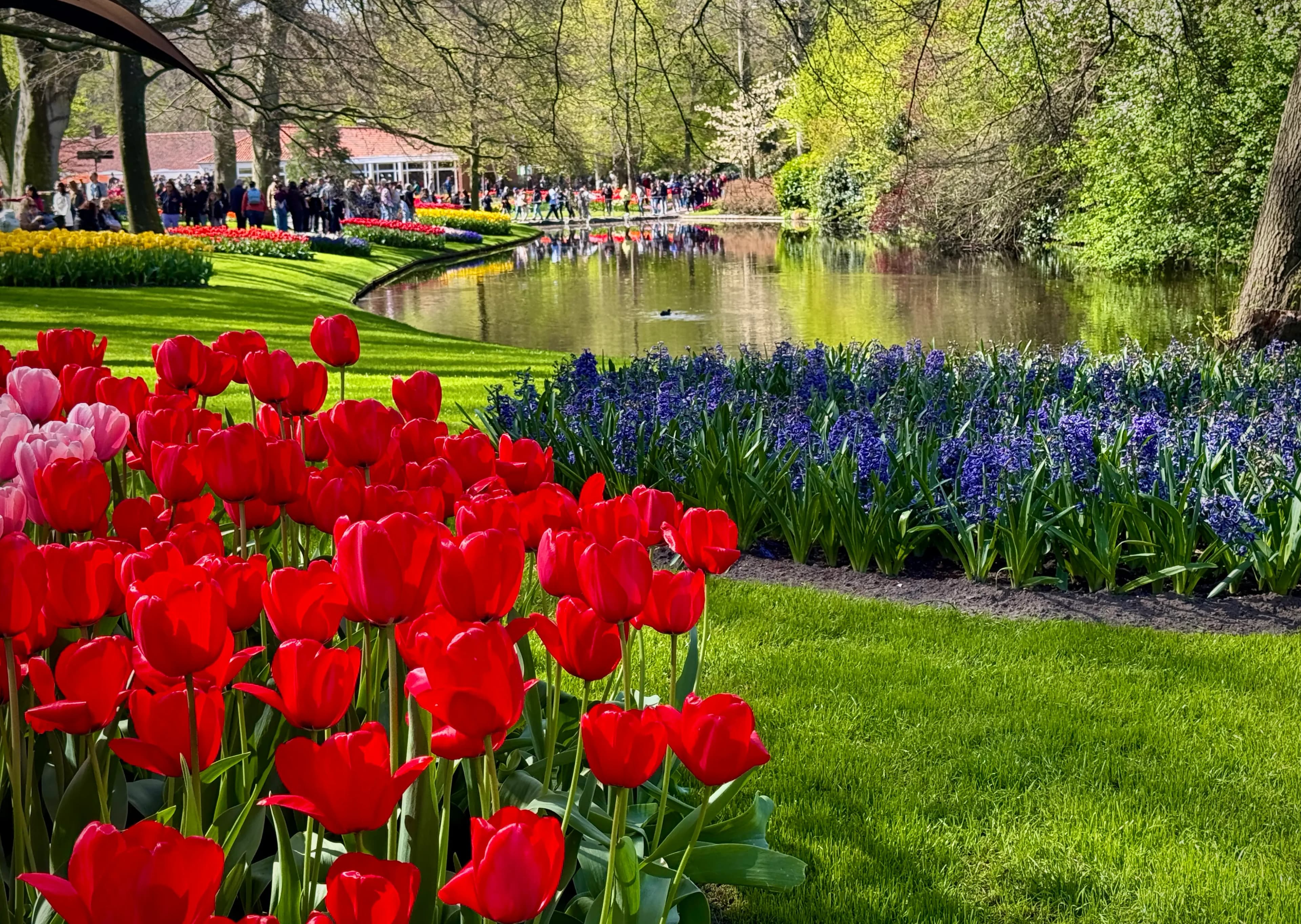
Known as the "Venice of the North," Amsterdam is famous for its canals, museums, bicycles, culture, houses, Dutch delicacies, and live-and-let-live attitude. But when it comes to spring, how can we forget about the tulip season? Millions of tourists visit Amsterdam every year just to experience the tulip fields in the spring season.
And just like everyone else, we also decided to visit Amsterdam in the spring. Yes, it was crowded because of the Easter holiday rush, but it was all worth it at the end.
In spring, the city becomes brighter, outdoor seating returns, and landscapes look beautiful and vibrant with their tulip blooms around the city. The king's day (Koningsdag) festival is also celebrated during spring. It's a massive celebration where the canals and streets transform into a high-spirited, orange-clad celebration of boat parties and flea markets.
I have put together this guide for first-time visitors who want the essentials, returning travelers who want to slow down and explore neighborhoods, and couples or solo travelers who like a clear plan with flexible pacing. These are the places that we have actually been to and the foods that we actually ate.
Quick spring tips before you go
Weather during spring in Amsterdam changes quickly, sometimes within the same afternoon. One moment the sky is clear and sunny, and the next moment it starts to rain.
We experienced this first-hand during one of our museum mornings. We had our ticket booked for the museum in the morning. It was chilly, so we were prepared, but after we came out from the museum, the sun was shining, and it was warm. So, weather here can really be unpredictable. So, pack layers, a light waterproof jacket, and shoes you can comfortably walk in for hours. The wind off the canals can make mild temperatures feel cooler.
Crowds build up from late March through April, especially on weekends or holidays. Book museum tickets early and plan outings early in the day. Anne Frank House tickets are released online on a weekly schedule and are for timed entry. The Van Gogh Museum also requires tickets with time slots mentioned. Reserve your date and time slot early if you are visiting Keukenhof (which you should visit). The park only operates during a fixed seasonal window.
Tulips and spring events (best for seasonal highlights)
Spring is one of the best times to be in Amsterdam. The whole city is in bloom, the weather is finally clearing up, and, of course, tulips are the star of the show.
Visit Keukenhof Gardens (tulip season)
Situated in Lisse, the Netherlands, Keukenhof Garden is one of the largest flower gardens and is also known as the "Garden of Europe." According to Wikipedia, it covers an area of 32 hectares, and approximately 7 million flower bulbs are planted with 800 types of tulips. You get to see rare tulip varieties here that you honestly won't find anywhere else in the world. Plus, they have the whole history of the tulip displayed there, which was actually pretty fascinating for me.
It was one of the best highlights of my trip, and I was blown away by the colors and the varieties. No matter where you turn, it's either a different shade or a different shape. It really is a bucket list experience.
It gets very busy and crowded as it attracts over a million visitors every year when it opens for the season. My best advice is to go as early as possible to beat the crowd. We also found that the edge of the park was quieter as compared to the center part of it.
Good to Know: For 2026, Keukenhof Garden is open from March 19 to May 10 (8:00 am to 7:30 pm). You can buy the tickets from their official website at around €21.50 for adults and €10 for kids. However, we actually booked a combined tour through GetYourGuide that included our transport and a visit to Zaanse Schans.
I actually wrote a separate, deep-dive guide with even more planning tips and photos, which you can read here: [Keukenhof Garden].
Attend the Amsterdam Tulip Festival
Apart from the tulip fields and tulip gardens that are located outside the city, you can also see tulips all around the city beautifully displayed in the historic center of Amsterdam. The Tulip Festival (often called the Tulp Festival) is an annual event that happens throughout the month of April, where flowering tulips are displayed at more than 85 locations in the city center. We loved stumbling upon these colorful planters during our visit.
Good to know: Check the official festival map online, which shows you exactly which museum gardens or public squares have the biggest displays.
Celebrate King's Day (Koningsdag)
The Dutch know how to have a good party, and for one day, the entire country comes together to celebrate King's Day (Koningsdag). It's the world's biggest birthday party to honor the birthday of their reigning monarch, King Willem-Alexander. On this day the whole city turns into one giant sea of orange (the color of the Royal House, the House of Orange-Nassau).
One of the coolest traditions is the nationwide vrijmarkt (free market). The government allows people to sell things on the street without a permit or paying taxes, turning the entire city into a massive flea market. It's especially fun for children and a great way to see the real joy of the Dutch people as they celebrate on the streets and along the canals. This one is on my bucket list until next time.
Good to know: This used to be Queen's Day on April 30th. However, when King Willem-Alexander took the throne in 2013, it became King's Day. For 2026 King's Day falls on Monday, April 27th.
Join the Locals at Aprilfeesten
The best part of traveling is when the best travel experience happens when you don't plan for it. We hadn't done any research about the Aprilfeesten, so after landing and checking into our hotel, we took the metro straight to Nieuwmark and walked right into the middle of the festival. It was a vibrant, swirling welcome to the city for us.
The Aprilfeesten is often called Amsterdam's "best-kept secret." It is a neighborhood-focused celebration that is much more intimate and community-driven than the massive city-wide parties. Organized by the residents of the Nieuwmarkt area, it gives bohemian and old-school vibes that are completely different from the commercial tourist hubs. The square turns into a nostalgic wonderland with various carnival attractions such as a miniature Ferris wheel and a classic swing ride with a backdrop of the medieval De Waag.
The center of attraction is the Spiegeltent (mirror tent). It's a 20th-century-style dance hall that hosts live music and dance throughout the week. We grabbed a drink and just sat back to people-watch. There is a Dutch concept called "gezelligheid," which refers to a unique sense of cozy, social belonging. Sitting there in the square, we really felt like a part of it.
Good to know: The festival is free to enter. However, to support the neighborhood organizers, you can buy a standard drink. They also usually use a sustainable cup-deposit system where you pay a small fee for your first cup and swap it for a clean one to help keep the historic square litter-free.
Neighborhood exploring (walks, canals, and outdoor time)
Wander the Jordaan canals and courtyards
Have you ever seen a picture of Amsterdam and thought, "I want to live there"? You must be seeing the Jordaan. It is famous for the "beating heart" of Amsterdam's authentic, old-world charm. It was built in the 17th century for the artisans, laborers, and immigrants who came to Amsterdam in search of work. Legend has it the name comes from the French word "jardin" (garden), which explains why so many streets here are named after flowers and trees.
The Jordaan has now become the most iconic neighborhood in the city. It's a maze of narrow streets, ivy-covered bridges, flower-filled alleys, and quiet canals. What makes it really special are the "hofjes" - hidden inner courtyards tucked behind unassuming doors. Many are private, but some are open to the public and offer a peaceful escape from the city noise.
The Jordaan is best explored by foot or by bicycle. While strolling through, you will see the Anne Frank House, Westerkerk, Noordermarkt, and cozy cafes. The two most iconic canals in the Jordaan are Prinsengracht and Bloemgracht. We spent hours wandering here, and honestly, that was one of the best experiences we had.
Good to know: If you are visiting on a Saturday morning, don't miss the famous Noorderamrkt. It's a local favorite where you can find organic food and antique treasures. Also, if you want to visit a "hofje," the Hofje van Brienen is one of the most beautiful ones that is usually open to the public during the day.
Explore the Nine Streets (De Negen Straatjes) for boutiques and cafés
Right on the edge of the Jordaan, you will find the Nine Streets, also known as "De Negen Straatjes" in Dutch. As the name indicates, it is a collective name given to the nine picturesque shopping streets in Amsterdam's canal belt. It's a paradise for shoppers with independent boutiques, vintage stores, and cozy cafes.
Even if you're not into shopping, the architecture here is stunning and well worth a visit. The streets cross the four main canals: Prinsengracht, Keizersgracht, Herengracht, and Singel. We have found the most unique souvenirs here that are much better than the typical tourist shops.
Good to know: These streets are narrow and can get packed on weekend afternoons. For the best photos, visit on a weekday morning. Also, keep in mind that many independent boutiques here don't open until late Monday morning. If you're a foodie, this is where you'll find those famous "viral" fry and sandwich shops - just be prepared to wait in line!
Visit Begijnhof (quiet historic courtyard)
If you need a break from the hustles and bustles of the city center, the Begijnhof is the perfect place to find some peace. It is one of the oldest "hofjes" in Amsterdam and was originally built in the 14th century as a sanctuary for the Beguines - a group of single and religious women who lived together in a community.
While walking through the entrance, it feels like hitting a "mute" button on the city. One minute you are on a busy shopping street, and the next, you're standing in a silent, grassy courtyard surrounded by beautiful tall houses. It was unbelievable for me that the Begijnhof is literally in the center of Amsterdam! It even houses the Houten Huys, which is one of the only two remaining wooden houses in the entire city.
Good to know: This is a private residential area where people still live today, so you must be very quiet and respectful while visiting. The entrance is a bit of a "hidden gem" - look for a heavy wooden door near the Spui square (close to the American Book Center). Entry is free, but they do close the gates to visitors in the evening.
Take a canal cruise (daytime or sunset)
Amsterdam is built on the canals, and the best and most practical way to see the canal ring's architecture and how the city is built is through a canal cruise. We took a classic canal boat that departed from the Open Havenfront in front of Central Station. It was a perfect way to see the leaning houses and historic bridges from a completely different perspective.
Our captain was also our guide, and he was great. He shared so many informative stories about the city's history that we wouldn't have known otherwise. We really liked the tour because it wasn't just a recording; it felt much more personal having the captain talk to us directly.
Good to know: There are multiple departure times throughout the day, so it's easy to fit into your schedule. If you have the GVB ticket we mentioned earlier, keep in mind it doesn't cover these cruises since they are run by private companies. We found it most convenient to just head to the docks near the station and hop on the next available boat.
Bike through the city like a local
Amsterdam is world-famous for its bicycles, and you'll see thousands of them everywhere you turn. While many people choose to rent a bike, we decided to skip the rental and just explore the city on foot. Honestly, we had so much fun just watching the locals navigate the "bike chaos" with such ease - sometimes while carrying groceries, kids, or even umbrellas. It's fascinating to see how the whole city is designed around cycling, but it can be a bit intimidating if you aren't used to dense bike traffic. If you're like us and prefer walking, you still get to be part of the atmosphere without the stress of navigating the busy bike lanes.
Good to know: Even if you aren't riding, you still have to be "bike aware." Always look both ways before crossing a street or a red-paved path, as those are dedicated bike lanes. They are fast and quiet, and they definitely have the right of way!
Spend time in Vondelpark
If you are thinking of soaking up the spring sun, you can head straight to the Vondelpark - the locals' backyard. Opened to the public in 1865, it is the largest and most famous public park in Amsterdam. In the spring, it is absolutely vibrant. While many people bike through the park, we loved exploring it on foot.
One of our favorite sights was seeing the colorful tulips literally floating on the water in the park's canals. The architecture inside the park is also stunning - don't miss the Vondelparkpaviljoen, a beautiful 19th-century building that looks incredible reflecting in the water on a sunny day. Whether you're people-watching or just enjoying the fresh air, it's a must-visit.
Good to know: The park can get very busy on sunny weekends, so if you're looking for a quieter experience, try to visit on a weekday morning. There are several cozy cafés inside the park, like Blauwe Theehuis, where you can grab a drink and enjoy the view.
Enjoy the 7 Bridges viewpoint on Reguliersgracht
If you are looking for that ultimate "postcard" view of the canals, this is it. There is a specific spot where the Reguliersgracht and Herengracht canals meet, and if you look down at the water, you can see seven stone bridges perfectly lined up in a row.
We saw this during our canal cruise, and it was such a cool perspective. From the water, you can look straight through the arches, creating a "tunnel" effect that you just can't see the same way from the street. Most boat captains will actually slow down here specifically so everyone can get a look at the alignment.
Good to know: If you want to see even more, there is a spot at the intersection of Reguliersgracht and Herengracht where, if you stand on the bridge and turn around, you can actually count 15 bridges at once in different directions! It's a bit of a challenge to spot them all, but it's a fun "scavenger hunt" for your walk.
Explore Dam Square and nearby streets
Located in the hiostorical and geographical center of Amsterdam, Dam Square is dominated by the Royal Palace (Koninklijk Paleis) and the Gothic Nieuwe Kerk on one side, with the National Monument - a tribute to WWII victims - on the other. We loved the atmosphere here.
It's also the gateway to some of the city's most famous streets. Kalverstraat, the busiest pedestrian shopping street, starts right here and is perfect if you're looking for high-street brands. If you walk north toward Central Station, you're on Damrak, and heading south takes you toward Rokin, which has some great hidden cafes tucked away in the side streets.
Good to know: Because it's so central, the square can get incredibly crowded with tourists, pigeons, and street performers. If you want to see the palace at its best without the massive crowds, try to get there early in the morning.
Culture and museums (plan these around timed tickets)
Spring is the perfect season for museums because you can balance indoor time with outdoor walking, and the city's major museums are clustered for convenience. However, because this is peak tourist season, you cannot just show up and expect to get in. Timed entry tickets are the golden rule here.
Visit the Rijksmuseum (and the gardens)
The Rijksmuseum is the largest and most famous museum in the Netherlands, housing 800 years of Dutch art and history within 8,000 objects. Originally founded in 1800 in The Hague, it was moved to Amsterdam by Louis Napoleon in 1808 and housed in the Royal Palace on Dam Square. The current iconic building, designed by architect Pierre Cuypers (who also designed Central Station), opened in 1885 and is a stunning mix of Neo-Gothic and Renaissance styles.
Beyond this masterpiece, you can explore the Cuypers Library, a breathtaking multi-story room that looks like it belongs in a movie. Other highlights include Petronella Oortman's Dollhouse, an incredibly detailed 17th-century status symbol that cost as much as a real house, and the Ship Models, which are handcrafted warships used to teach 17th-century sailors.
Good to know: You must book a timed entry ticket online in advance; they do not sell tickets at the door. The Rijksmuseum Gardens are free to enter and are absolutely beautiful in the spring. You can walk through the famous tunnel that cuts through the museum and then relax among the tulips and sculptures in the outdoor courtyards.
Visit the Van Gogh Museum (book an early slot)
Even for those who aren't usually "museum people," the Van Gogh Museum is a bucket list destination. It houses the world's largest collection of artworks by Vincent van Gogh, featuring over 200 paintings, 500 drawings, and 700 letters. The museum is brilliantly organized to take you through the different phases of Vincent's life, from his early, somber Dutch works like The Potato Eaters to the explosion of color in his final years in France. Learning about the man behind the canvas is just as fascinating as the art itself; the galleries tell the story of his close relationship with his brother Theo and his intense, often tragic, search for meaning through his art. The collection includes some of the most famous paintings in history, such as "Sunflowers," "Almond Blossom," and several of his intense self-portraits. Even the building itself is a masterpiece of modern architecture, located right on the Museumplein, where the vibrant green lawns offer a great place to relax between gallery visits.
Good to know: This is one of the most popular museums in the world, and tickets are only available online with a specific time slot. They sell out incredibly fast, especially during the spring tulip season. If you want to see the Sunflowers in person, you need to book your tickets several weeks in advance.
Visit the Anne Frank House (book ahead)
Located on the Prinsengracht canal, the Anne Frank House is one of the most significant historical sites in the world. It is the actual building where Anne Frank and her family hid from the Nazis for over two years in a concealed "Secret Annex."
Standing outside the house, you can really feel the weight of history. Even the surrounding neighborhood of the Jordaan takes on a different meaning when you realize what was happening behind those canal house windows. Right next door is the Westerkerk, the tall church whose bells Anne mentioned hearing in her diary.
Good to know: This is the most difficult ticket to get in Amsterdam. Tickets are released every Tuesday at 10:00 am CET for visits six weeks later. They sell out almost instantly, so you have to be ready to book the moment they go live! If you can't get a ticket, it's still worth walking by to see the memorial statue of Anne nearby and to reflect on the history of the area.
See the Rembrandt House Museum
While the Rijksmuseum shows you Rembrandt's finished masterpieces, this museum lets you step into his actual life. Located on Jodenbreestraat, this is the townhouse where Rembrandt lived and worked at the height of his fame. The rooms look exactly as they did in the 17th century because the museum was restored using a list made by debt collectors when Rembrandt went bankrupt.
The highlight is the Great Studio, where he painted his most famous works, and his "Cabinet of Curiosities," which is packed with exotic items he collected, like tropical shells and Roman busts. You can even see his tiny box-bed and the original oak press used for his famous etchings.
Good to know: You need to book a timed entry ticket online in advance. After your visit, look across the canal at De Sluyswacht. It's a 17th-century lock-keeper's house that is visibly leaning to one side.
Visit the Royal Palace of Amsterdam (Koninklijk Paleis)
Standing in the middle of Dam Square, you can't help but be intimidated by the scale of the Royal Palace. What I found most interesting is that it wasn't actually built for a king. It opened in 1655 as the city's Town Hall. Back then, it was so grand that people called it the "Eighth Wonder of the World." It only turned into a palace in the 1808 when Napoleon's brother, Louis, decided he wanted it for himself and moved in.
The real "wow" moment happens when you walk into the Citizen's Hall. It's this massive, echoing room made of white marble that feels incredibly powerful. If you look down at your feet, you'll see the entire world map from the 17th century is inlaid right into the floor. It was the city's way of saying that Amsterdam was the center of the universe.
Good to know: Since the Dutch Royal House still uses this for official state visits, they sometimes close it to the public without much notice. It's a good idea to check their schedule and grab a timed ticket online so you don't get turned away at the door.
Food, cafés, and markets (simple additions that improve your trip)
Spring is a strong season for markets and café stops because you can take breaks outside without committing to long indoor meals. There is something so "Amsterdam" about grabbing a quick snack from a street stall and sitting on the edge of a canal to eat it while the boats go by.
Browse the Flower Market (Bloemenmarkt)
No trip to Amsterdam in the spring is complete without a visit to the Bloemenmarkt. Founded in 1862, the market is located on the Singel canal between Muntplein and Koningsplein and is the world's only floating flower market. What makes it so unique is that the stalls are actually permanently moored houseboats - a relic from the days when growers would sail their barges into the city center to sell their blooms directly from the water.
While many of the stalls have shifted toward selling souvenirs like hand-painted wooden tulips, ceramic clogs, and local cheeses, you can still find vendors selling fresh, seasonal bouquets. It's the perfect place to just wander, take photos of the vibrant displays, and soak up that "flower power" energy that defines the city.
Good to know: The market is open every day, but for the best photos and fewer crowds, try to get there around 9:00 am just as the stalls are opening.
Explore De Pijp and the Albert Cuyp Market (street food and snacks)
If you want to feel the real "vibe" of Amsterdam outside the tourist center, head to De Pijp. Once a working-class neighborhood, it's now the city's trendy Latin Quarter. The star of the show here is the Albert Cuyp Market, which has been around since 1905. I love visiting a local market in every city I travel to, and this one did not disappoint.
We spent our time wandering past hundreds of stalls, but the highlight was definitely the street food. We tried the Kibbeling (traditional Dutch fried fish), which was perfectly crispy, and some local snacks topped with a delicious, melted cheese sauce. We even got to try some rich chocolate brownie samples that were hard to resist!
Beyond the food, it's a great place to pick up authentic souvenirs. I made sure to grab a few things here because the prices and selection felt much more local than the shops in the city center.
Good to know: The market is open Monday through Saturday from 9:00 am to 5:00 pm. It's closed on Sundays, so plan your visit accordingly! It can get very crowded, so if you want to eat your way through the stalls without the massive lines, try to get there before the lunch rush.
Try Dutch treats like stroopwafels and poffertjes
Spring is an ideal season for exploring Amsterdam's food scene because the milder weather allows for quick outdoor breaks between sightseeing stops. You'll find classic treats everywhere from specialized shops to market stalls:
Dutch Fries (Patat): These are thick-cut, double-fried potatoes that are a local staple. They are often served in a paper cone and topped with a generous mountain of shredded Dutch cheese and signature sauces like truffle mayonnaise or curry ketchup. Stroopwafels: A national treasure consisting of two thin, crispy waffle layers joined by a warm, gooey caramel center. They originated in Gouda as a way to use leftover bakery crumbs. Poffertjes: Tiny, fluffy buckwheat pancakes that are traditionally served with a large knob of melting butter and a heavy dusting of powdered sugar. Kaassoufflés: A savory, deep-fried breaded cheese wrap that is a perfect quick bite. You can often find these in a FEBO, a unique "snack wall" where you purchase items directly from small glass vending windows. Dutch Apple Pie: A common find at traditional cafés, this pie is distinguished by its deep lattice crust and cinnamon-heavy filling. It is typically served with a large dollop of fresh whipped cream.
Good to know: To enjoy a packaged Stroopwafel like a local, rest it over a steaming cup of coffee to melt the caramel.
Do a walking tour (history, food, or neighborhoods)
We always like to start our day in any new city with a walking tour so we can get a feel for the history before we start exploring on our own. In Amsterdam, this is especially helpful because having a local expert lead the way means you aren't just looking at pretty buildings, but you're hearing the specific stories that bring the canals and cobblestones to life through a deep historical narrative. These tours offer a personal perspective you won't find in a guidebook, providing a fast pass to the soul of the city with insider recommendations on where to find the best local coffee or a quiet place to rest. Taking a tour early in your trip is also a great way to get your bearings and understand the flow of the different neighborhoods you might want to revisit later. Expert guides often lead you to hidden gems that most visitors miss, such as peaceful "hofjes" (hidden courtyards) or narrow alleys with fascinating architectural quirks that explain why the houses lean the way they do. It turns a simple stroll into an immersive experience where you learn the "why" behind the city's unique layout, making the rest of your trip feel much more connected to the local culture.
Good to know: Most guided walks start at central landmarks like Dam Square or Beursplein, and if you choose a tips-based tour, it is standard etiquette to give the guide between €10 and €20 per person based on the quality of the experience.
Experience Cannabis Culture at a Coffeeshop
You cannot talk about Amsterdam without talking about its cannabis culture. The city is world-famous for its "coffeeshops." and like many visitors, we were curious about what was behind it all. It's important to know the difference between a "cafe," where you get coffee and a slice of cake, and a "coffeeshop," where cannabis is sold and consumed.
The history of cannabis culture is pretty fascinating. A policy was made in the 1970s called gedoogbeleid, or "tolerance," which basically means that the Dutch government decided that instead of fighting a losing war on soft drugs, they would regulate them to keep people away from "harder" substances. This became the unique culture where these shops became social hubs where incredibly helpful staff acts more like herbalists than bartenders. Even if you're not interested in buying anything, some shops are worth a peek just for the decor and the relaxed, friendly atmosphere.
We stopped by The Jolly Joker, which was right on the edge of Nieuwmarkt square. It's a family-owned coffesshop and has been around since 1981. The vibe was great, cozy, and warm. We liked the seating area. You can sit by the window upstairs and get a perfect view of the area. The staff were nice and gave their recommendation to us as beginners.
Good to know: To identify a licensed coffeeshop, look for the official green and white sticker in the window. Most coffeeshops are strictly 18+ and do not sell alcohol, and you are limited to a purchase of five grams per day. If you're visiting in the summer, the open-window seats at places like Jolly Joker are some of the best people-watching spots in the city.
Go To Red Light District
The Red Light District is the oldest neighborhood in Amsterdam, and in the local language, it is also known as De Wallen. Earlier this area used to serve as a bustling port for sailors. Today. It's a mix of narrow medieval alleys, glowing red windows, and massive crowds of tourists. Interestingly, during the daytime, you might not realize where you are; the area feels like a typical Amsterdam neighborhood. Only in the night did the area start to light up in the iconic red-lit atmosphere, and the neon signs took over the canals.
The culture here is centered around being very open and regulated regarding sex work, which was legalized in the Netherlands in 2000 to improve safety and health standards for workers. We went there, but personally, we did not like it. Even with the historical significance, it was overwhelming for us. It is often included in the first-time itineraries mostly because of the curiosity and hype around it. It was very touristy, as many people come specifically for the shock value or to party. There is also a Red Lights Secrets Museum, which represents the history and reality of the profession.
If you're like us, you can keep your visit small and enjoy other beautiful historical landmarks hidden in plain sight, such as Oude Kerk (the city's oldest building) or the Museum of Ons' Lieve Heer op Solder, a secret 17th-century church tucked away in an attic, or you can just walk alongside the canal to enjoy the beautiful lights and its coziness.
Good to know: Taking photos of the workers in the windows is strictly forbidden and can lead to phones being confiscated or even thrown into the canal by the local security. If you want to see the historic architecture of De Wallen, try to visit on a weekday morning when the area is quiet and feels like a normal neighborhood.
Eat around the City
Whenever we travel to a new country, food is always at the top of our priority list. In Amsterdam, the food scene is a huge part of the adventure. Especially in spring, where you get to experience the local food outside. You can easily spend a day experiencing the food on your own or can book the guided food tour where you'll get to learn the culture and history behind the cuisine. We loved exploring the culinary landscape on our own.
Here are a few of the spots we loved exploring:
Albert Cuypmarkt: This one was our favorite because it gives the local vibes. We found the local Dutch delicacies by the local vendor. It was amazing wandering through this local market. It's the perfect place to sample different Dutch cheeses and grab a fresh stroopwafel.
The Black Dog: We had dinner here and absolutely loved the ambiance and the service. It's a great spot for a high-quality, relaxing meal.
Cafe Hill Street Blues: Located right on the Damrak, this was our favorite spot for coffee. The views are amazing, and the sitting area has such a cool, unique vibe. Fabel Friet & Local Fries: I tried a variety of fries across the city. Fabel Friet is a must, but honestly, grabbing hot fries with local sauces at different locations was one of our favorite simple pleasures.
Beyond traditional Dutch snacks, the city is famous for its Indonesian cuisine, a legacy of the Netherlands' colonial history. It is a favorite among locals and widely available throughout the city. A popular way to experience this is through a Rijsttafel (Rice Table), a festive meal featuring a variety of small, flavorful dishes such as chicken satay, gado-gado (vegetables in peanut sauce), and spicy tofu or tempeh served alongside rice.
Good to know: remember that an Indonesian Rijsttafel is a massive feast usually intended for sharing. Many snack stalls and cafes are now card-only, so having a contactless payment method ready is essential for quick stops.
Easy day trips from Amsterdam (simple planning, big payoff)
Day trip to Zaanse Schans for windmills
Zaanse Schans is often called a "living open-air museum," but it has a fascinating origin story. In the 1960s, as modern industry began to expand in the Zaan region, many historic 18th- and 19th-century buildings were at risk of being torn down. To save them, an entire neighborhood of green wooden houses and massive windmills was moved here by road and water to preserve the region's heritage.
Highlights of our visit:
Dutch Cheese Tasting: We visited a local cheese farm where we learned about the production process. It is a tradition that has been central to Dutch life for centuries. We got to sample a huge variety of flavors, which was easily a favorite part.
Wooden Shoe Workshop: We watched a live demonstration of how traditional Dutch clogs are carved. While they're a tourist icon now, they were originally essential safety gear for farmers and laborers working in the wet Dutch fields.
The Windmills: We explored the area and saw the windmills from the outside. While most were moved here, a couple like the dye mill De Kat are still on their original 17th-century foundations, still grinding pigments for artists today just as they did hundreds of years ago.
Pro Tip to Avoid Crowds: Because Zaanse Schans is a preserved residential neighborhood, it wasn't originally designed for millions of visitors. To avoid the tourists completely, you need to arrive much earlier than the main tour buses (aim for 8:30 or 9:00 AM). If you are doing a combined tour like we did, it will likely be busy, but the historical charm still shines through!
Final thoughts
Amsterdam in spring is not just a destination; it's a mood. It's a mix of vibrant colors, neighborhood festivals, frantic bike bells, chaos, and those quiet "gezellig" moments that sneak up when you least expect them. It might be crowded during the Easter rush, and the weather will definitely keep you on your toes, but that's part of the authentic Dutch experience.
Which of these 25 things is going straight to the top of your spring bucket list?
Leave a Comment
Comments
No comments yet. Be the first to comment!